I used to think the word family meant your guard could come down.
That was before the bathroom door.
That was before the sound—raw, animal, too-big-for-such-a-small-body—hit the hallway like a siren and turned the air sharp in my lungs. Before my hand found the knob and it didn’t give. Before I heard my toddler choke on her own cries and say my name the way people say it when they think they might disappear.
arrow_forward_ios
Watch MorePause
00:00
00:07
05:09Mute
Powered by
GliaStudios
“Mommy! Mommy—hot! Hot!”
The lock was one of those flimsy privacy latches, the kind you could pop with a coin. We’d moved into my parents’ house for “just a few weeks,” which was the lie we told ourselves so it didn’t feel like surrender. A transitional season. A reset. A chance to save money after my separation. A chance for my daughter, Lila, to have her grandparents’ backyard, her aunt’s silly songs, the whole warm idea of home.
I could still smell my mother’s lemon cleaner from where she’d scrubbed the hallway baseboards that morning like the world could be made safe with enough elbow grease. It mixed with something else—steam, maybe, or that faint mineral tang you only notice near running water.
I put my shoulder into the door. It flexed. Not enough.
“Open it!” I yelled, already shaking, already furious at myself for letting anyone take Lila behind a closed door. “Lila, baby, I’m right here!”
On the other side, another voice—my sister Celeste’s—calm in a way that made my skin crawl.
“She’s fine,” she said, like we were talking about spilled juice. “She’s having a fit.”
Then my daughter screamed again, and the sound punched straight through me.
My fingers fumbled for anything metal. My keys. My necklace clasp. A bobby pin I didn’t have. My hands were slick with panic, and the knob felt suddenly like the handle of something living, resisting me.
“Celeste,” I said, and my voice went low, a warning I didn’t know I had. “Open. The. Door.”
“She needs to learn,” my sister said, still too even. “You’ve been babying her. It’s why she’s like this.”
My mind tried to make those words harmless. Tried to translate them into something reasonable: potty training; tantrum; she doesn’t want shampoo in her hair. Tried to give my sister the benefit of a doubt I’d been trained to extend like a family heirloom.
But then Lila screamed, “It burns!”
Something in me snapped cleanly, like a twig.
I grabbed the edge of the door with both hands and yanked until the latch gave with a cheap, offended click. The door swung inward. Steam rolled out like a breath.
The bathroom was bright and white and wrong.
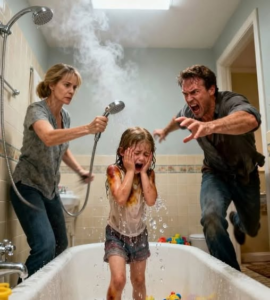
Lila was on the bath mat, naked, curled into herself like she was trying to vanish. Her cheeks were red—too red—and her chin glistened with water. Her eyes were squeezed shut so tight her eyelashes stuck together. She was shaking so hard her teeth clacked.
Celeste was standing over her, holding the detachable showerhead like it was a microphone. Her hair was twisted up, her face composed, her lips set in that patient line she used when she wanted to look like the adult in the room.
The tub faucet was still running. The water coming out sounded normal. Looked normal. But the steam told the truth.
I lunged for my daughter, scooping her up against my chest. Her skin was hot—hot in a way skin should not be. She clawed at my shirt, burying her face in me, sobbing into my collarbone.
“Why is it so hot?” I demanded, my eyes darting to the faucet handle. It was turned almost all the way to the left.
Celeste shrugged. “She was stealing again.”
I blinked. “What?”
“She took cookies from the pantry,” Celeste said. “After I told her no.”
“She’s two,” I said, like that explained the entire universe.
“She knows what ‘no’ means,” Celeste replied. “And you don’t correct her. You just—” She waved her hand vaguely, like comfort was a bad habit. “—coddle.”
I tightened my hold on Lila. My daughter’s sobs hitched into those little gasping inhales that meant she was past comfort and into shock.
Celeste looked down at her, not unkindly, but with a blankness that made my stomach flip. “I didn’t hurt her. I turned it warm. She overreacted.”
I stared at the running faucet. Steam. The red flush climbing my child’s face. Her trembling limbs. The way she kept whispering “hot, hot, hot” into my shirt like it was a prayer.
I reached out and turned the handle to cold. The steam thinned, reluctant.
“Get out,” I said.
Celeste’s eyebrows lifted. “Excuse me?”
“Get out of the bathroom,” I said, clearer now, my voice steady in a way my insides were not. “Now.”
She didn’t move. Instead she crossed her arms. “You’re making this bigger than it is.”
I didn’t raise my voice. I didn’t have to. “Leave.”
Celeste’s mouth tightened. The calm cracked just enough for irritation to show. “You’re going to undermine me in front of her? That’s exactly the problem.”
I didn’t answer. I stepped sideways, shielding Lila, and I walked past her into the hallway.
Behind me, Celeste called after us, “If you keep letting her run you, you’re going to raise a monster!”
The word monster followed me like a stain.
I carried Lila to my room and set her gently on the bed, wrapping her in the softest towel I could find. Her skin was still flushed. When I touched her cheek, she flinched like my hand was a threat.
That flinch hollowed me out.
“Baby,” I whispered, forcing my voice to stay warm even as something cold rose in my throat. “Mommy’s here. You’re safe. You’re safe, okay?”
Lila hiccuped and clung to my wrist with tiny, furious strength. “Auntie… hot,” she mumbled.
“I know,” I said, and my eyes burned. “I know.”
I grabbed my phone and dialed 911 before my brain could argue me out of it.
The operator’s voice was steady, practiced. “What’s your emergency?”
I looked at my daughter’s face again and felt rage tighten like a fist.
“My sister scalded my toddler,” I said. “I need an ambulance.”
The room felt like it shrank around the words. Like saying it made it real in a way my mind couldn’t undo.
“Is she breathing?” the operator asked. “Is she conscious?”
“Yes,” I said. “She’s crying. Her face is red. The water was—too hot.”
“Do you see blistering?” the operator asked.
I leaned closer, scanning. Her cheeks were raw and red, her chin too. Her neck showed patches where the water must have hit. I didn’t want to see more. I didn’t want to look and have the answer be worse.
“I don’t know,” I admitted, my voice shaking. “It’s red. Really red.”
“Okay,” the operator said. “Cool water, not ice, and don’t apply ointments. The ambulance is on the way.”
Cool water. I’d already turned it cold in the bathroom. I grabbed a clean washcloth, wet it with cool water from my mini-fridge bottle, and pressed it gently to Lila’s cheek. She whimpered and tried to pull away.
“I’m sorry,” I whispered. “I’m sorry, honey.”
I heard footsteps in the hallway—fast, purposeful. A knock that wasn’t a knock, more like a demand.
“Open the door,” my mother called.
I didn’t. I couldn’t leave my daughter.
The door opened anyway. My mother stepped inside, her eyes wide, her hair still in curlers, her hand over her mouth like she’d walked into a tragedy she didn’t have time for.
“What happened?” she asked, then her gaze landed on Lila’s face. “Oh my God.”
Behind her, my father appeared, tall and silent and already angry in that controlled way he had, the way he used to get before he took the belt off the hook when we were kids and called it “teaching respect.”
Celeste came last, arms folded, chin up, her expression set like she’d already been judged unfairly and was ready to defend herself.
“She’s fine,” Celeste said again. “She’s just dramatic.”
My mother’s eyes flicked to Celeste. “What did you do?”
“I disciplined her,” Celeste said. “She stole cookies. She’s been acting out. I was helping.”
My father’s jaw worked. “With hot water?”
Celeste rolled her eyes. “It wasn’t hot. It was warm. She freaked out.”
My mother looked at me. “Did you call anyone?”
“I called an ambulance,” I said.
The silence that followed had weight. Like I’d slapped them.
My mother’s face shifted from horror to something else—fear, maybe, but not for Lila.
“You called—” she started.
“Yes,” I snapped. “Because my daughter is hurt.”
My father’s voice went low. “Do you understand what you’ve done?”
My hands tightened on the washcloth. “Do you understand what she did?”
Celeste’s calm returned like a mask snapping into place. “You’re making it sound like I abused her.”
“You locked the door,” I said, and my voice shook now with fury. “You turned the water hot. You held the showerhead to her face while she screamed.”
Celeste scoffed. “That’s not what happened.”
I stared at her, truly stared, and realized with a sick jolt that she believed her own version. Or at least believed it would be believed.
My mother stepped closer to the bed, her voice softer. “Honey, you’re upset. We’ll take her to urgent care. We don’t need—sirens—people—”
“No,” I said. “No. We’re not smoothing this over. Not this.”
My father’s eyes hardened. “Celeste was trying to help you. You’ve been a mess since the separation. You’ve been sleeping in, letting the kid run wild, and Celeste stepped in like family does.”
My blood went cold. “You think this is stepping in?”
“She’s always been stricter,” my mother said quickly, like strictness was a personality quirk and not a warning sign. “But she loves Lila. She wouldn’t hurt her.”
Lila whimpered at the sound of Celeste’s name. That tiny sound cut through everything.
“She’s scared,” I said, gesturing at my daughter. “Look at her.”
My mother’s eyes filled. For a second, I thought she’d come to her senses. But then she glanced toward the hallway, toward the front window, as if imagining the neighbors peeking out.
“An ambulance will bring police,” she whispered.
“Good,” I said.
Celeste’s eyes narrowed. “Are you serious? You’re going to ruin my life over a toddler tantrum?”
I stood so fast the bed creaked. “Get out,” I said again, and it was different this time—less request, more warning. “Get out of this room.”
Celeste didn’t flinch. “You’re unstable.”
My father’s gaze snapped to me. “Watch your mouth.”
“No,” I said, and my voice rose now, loud enough to shake. “You watch yours. You’re all standing here like my daughter’s pain is a family inconvenience.”
My mother’s voice cracked. “We’re not saying that—”
“You’re saying it with every excuse,” I said. “You’re saying it by worrying about the neighbors. By acting like I’m the problem for calling for help.”
Lila’s sobs were quieter now, exhausted. She was leaning into the towel, eyes half-lidded.
I sat back down and took her hand in mine. Her fingers were damp and cold against my palm.
The sirens came ten minutes later, though it felt like an hour. Red and blue lights flashed across the living room walls, painting our family photos in emergency colors. I could hear Celeste downstairs talking fast, laughing lightly like she was hosting guests.
When the EMTs came in, their faces shifted immediately when they saw Lila. They were kind, efficient. One of them crouched down, spoke to her like she was a person with agency, not a problem to manage.
“Hey sweetheart,” she said. “I’m Jess. Can I take a look at your face?”
Lila pressed into me. “No.”
“It’s okay,” Jess said gently. “Mom stays. I just want to make you feel better.”
I watched them assess the redness, the sensitivity, the patches along her chin and neck. Jess asked what happened. I told the truth. Celeste tried to interrupt twice with her version—“It was warm,” “She’s dramatic”—until the male EMT held up a hand and said, “Ma’am, please let her mother answer.”
Police arrived shortly after. Two officers, one older man with tired eyes and one younger woman who looked like she’d seen too many ugly things and kept going anyway.
They separated us. They asked me questions in the kitchen while Lila was taken to the ambulance. They asked Celeste questions in the living room. My parents hovered, brittle and offended.
“Do you want to press charges?” the older officer asked me.
I looked through the kitchen doorway and saw my father’s face twist at the word charges, as if it was a betrayal.
“Yes,” I said.
My mother made a sound like she’d been struck. “Please,” she whispered. “Please don’t do this.”
I didn’t look at her. “This was done to my child. I’m not doing anything. I’m responding.”
Celeste’s voice rose from the living room, sharp now. “This is insane! She’s trying to get back at me because she’s jealous!”
Jealous. Of what? A woman who locked my toddler in a bathroom?
The younger officer came into the kitchen and spoke quietly to her partner. “We’ll need a report,” she said. “And we should notify CPS.”
My father slammed his palm against the counter. “CPS? Over a little red skin?”
The younger officer’s eyes were steady. “Over an allegation of intentionally scalding a child. Yes.”
“It wasn’t intentional,” my mother cried.
I turned to her then. “Was locking the door an accident?”
My mother’s mouth opened. Closed.
In the ambulance, Lila was small on the stretcher, wrapped in blankets like a burrito, her cheeks still raw. I sat beside her and held her hand. She stared at the ceiling with wet, exhausted eyes.
“Mommy,” she whispered. “I was sorry.”
I swallowed hard. “You don’t have to be sorry,” I said. “You never have to be sorry for being hurt.”
Her brows pinched in confusion, like that concept didn’t fit in her world yet.
At the hospital, the fluorescent lights made everything look harsher. Doctors checked her. They confirmed it was a superficial scald—first-degree, maybe bordering on second in a few small spots, but no severe blistering. “She’ll be sore for a few days,” the doctor said. “We’ll give you instructions. Cool compresses, pain control, watch for signs of infection.”
Relief should have made me collapse. Instead it fueled me, hot and relentless. Because if it had been worse—if I had waited—if I hadn’t forced that door—
A social worker came in next. She introduced herself, asked me to tell the story again. I did, my voice cracking in the middle, my hands shaking so hard I had to grip the chair.
She listened without flinching, without smoothing it over. When I finished, she nodded once, like she believed me. “You did the right thing,” she said.
Those words hit me harder than I expected. My throat tightened.
Outside the ER room, my mother called my phone ten times. My father texted once: You’re tearing this family apart.
Celeste didn’t call. She didn’t need to. Her voice was already in the house, in my childhood, in every moment she’d ever gotten away with something because she looked composed while I looked emotional.
When we finally went home—because we had nowhere else to go—I refused to step back into that house.
I called my friend Mariah at midnight, voice ragged. “Can I come over?” I asked. “Just for a few nights.”
Mariah didn’t hesitate. “Bring your baby,” she said. “I’ll make up the couch.”
I packed fast. Lila slept fitfully, waking every hour and crying if the room was too quiet. I moved through my parents’ house like a ghost, stuffing clothes and diapers into bags. In the hallway, I passed the bathroom door and felt bile rise.
Celeste stood in the kitchen when I came down with the last bag, sipping tea like a villain in a daytime drama.
“You’re really doing this,” she said.
“I’m protecting my child,” I replied.
Celeste’s eyes glinted. “From what? A lesson?”
I stopped and looked at her. Really looked. My sister had always been good at making herself seem reasonable. She’d been the straight-A kid, the one who “never talked back,” the one who got praised for being “mature.” I’d been the one who cried, who got labeled dramatic, who was told to toughen up.
It hit me then that we weren’t having a misunderstanding. We were having a collision between two realities.
“Don’t call it discipline,” I said. “Call it what it is.”
Celeste smiled slightly. “You can call it whatever you want. They’ll believe me.”
My hands clenched around the bag strap. I didn’t move toward her. I didn’t give her the satisfaction of a scene she could later describe as me being unstable.
Instead I said, “Not this time.”
And I left.
For a week, I lived on Mariah’s couch. Lila’s face healed in visible stages—red fading to pink, sensitivity easing, the tiny flinch disappearing slowly. But her sleep didn’t heal as quickly. She started startling at running water. She cried when I turned on the shower. She clung to me if anyone tried to pick her up.
Every time she reacted, I felt the urge to tear something apart with my bare hands.
CPS came to interview me. They came to interview my parents. They requested medical records, police reports, photographs. I had taken pictures that first night in the hospital with shaking hands because the doctor told me to document. I hated myself for needing proof of my child’s pain, but I took them anyway. The images made my stomach twist.
My mother’s messages shifted from pleading to furious.
How could you do this to your sister?
You’re humiliating us.
The neighbors are talking.
Then, two days later:
Your father says if you don’t drop this, you’re not welcome back.
As if being unwelcome was the threat, not being unsafe.
My father called once, voice cold. “Celeste is devastated,” he said. “She can’t sleep. She’s afraid she’ll lose her job. What do you want?”
I stared at my phone and thought of Lila’s whisper—I was sorry.
“I want my daughter to be safe,” I said. “I want someone to tell Celeste she can’t do that again. Not to Lila. Not to anyone.”
“She won’t,” he snapped. “It was a mistake.”
“It was a choice,” I said, and my voice broke on the word. “And you’re choosing her over your granddaughter.”
He went quiet. Then he said, “You’ve always been difficult.”
The call ended with that sentence hanging in my ear like a hook.
The family took sides the way people do when truth is inconvenient.
My aunt Linda posted vague quotes on Facebook about “loyalty” and “blood.” My cousin texted me, I’m sorry, but Celeste says you’re exaggerating. Was it really that bad?
Even my brother, Evan, called to “understand both sides,” which is what you say when you’re afraid to upset the people who raised you.
“She said Lila was acting out,” he told me, voice strained. “She said she barely turned it warm.”
“She locked the door,” I said.
Evan sighed. “Maybe she panicked. She doesn’t have kids. She thought—”
“She thought hurting a kid would teach her a lesson,” I snapped. “And you’re helping her hide.”
There was a pause. Then Evan said quietly, “Dad’s been calling you crazy all week.”
I laughed once, harsh. “Of course he has.”
“I don’t think you’re crazy,” Evan said. “I just… I don’t know how to fix this.”
“You don’t fix it,” I said. “You pick a side. That’s what’s happening whether you like it or not.”
Evan didn’t answer.
When the police detective assigned to the case called me, I was sitting on Mariah’s floor building a tower of blocks with Lila, trying to teach her that loud noises could be fun again.
“We have your statement and the medical report,” the detective said. “We’re also reviewing the 911 call. We’ll need to speak with your sister again.”
“Okay,” I said, my throat tight. “Thank you.”
“Ms. Hart,” he continued, “has anyone in your family tried to pressure you to recant?”
“Yes,” I said, and I couldn’t keep the bitterness out.
“Document it,” he said. “Save texts. Save voicemails. That matters.”
After I hung up, I stared at my phone. It felt like holding a bomb.
Two nights later, my mother showed up at Mariah’s door.
I opened it because some part of me still wanted her to be my mother. Still wanted her to wrap her arms around me and say she was sorry, that she’d been wrong, that she’d protect her granddaughter no matter what.
Instead she stood on the porch in a wool coat, eyes bright with anger.
“You’re poisoning everyone against us,” she said without greeting.
I stepped outside and closed the door behind me. “You did that yourselves.”
My mother’s hands shook as she held them together. “Celeste is your sister.”
“And Lila is your granddaughter,” I said.
My mother’s eyes darted to the window, like she expected Lila to appear. “Where is she?”
“Inside,” I said, instinctively blocking.
My mother’s voice rose. “You’re keeping her from us.”
“I’m keeping her safe.”
My mother scoffed. “Safe? From what? A bath?”
The words were so outrageous I couldn’t respond for a second. It was like hearing someone call the sky green.
“You saw her face,” I said. “You saw her shaking.”
My mother’s jaw tightened. “Kids cry. Kids overreact. You’re turning this into abuse because you hate Celeste.”
I felt my vision sharpen. “I don’t hate her,” I said, and surprised myself with the truth. “I’m terrified of her. There’s a difference.”
My mother looked at me like I’d spoken in another language. “Celeste is strong,” she said, like strength was a shield.
“No,” I said. “Celeste is cruel when she thinks she’s right.”
My mother’s eyes filled with tears that looked real. “If you go through with this,” she whispered, “we could lose everything. We could—”
“You could lose your image,” I said softly. “That’s what you mean.”
My mother flinched as if slapped.
“I raised you,” she hissed. “I fed you. I sacrificed—”
“And I’m grateful,” I said, voice shaking now. “But you don’t get to cash in that gratitude to protect someone who hurt my child.”
My mother’s face twisted. “So that’s it. You’re choosing strangers over your family.”
I thought of the EMT named Jess, who’d spoken gently to my daughter. I thought of the social worker who’d said I did the right thing. I thought of the young officer who’d looked at me like my fear made sense.
“I’m choosing Lila,” I said. “I’m choosing the kind of family I want her to have.”
My mother stared at me a long moment, then turned and walked down the steps without another word.
When the door clicked shut behind her, I leaned against it and slid to the floor, shaking silently. Mariah knelt beside me and didn’t ask questions, just pressed her shoulder against mine like an anchor.
In the weeks that followed, everything became paperwork and waiting and small moments of terror.
Celeste’s lawyer sent a letter threatening to sue for defamation. My father left a voicemail calling me “vindictive.” My aunt Linda posted a new quote about “forgiveness” with a heart emoji.
At night, I replayed the bathroom scene until it looped in my head like a glitch. I’d wake up sweating, convinced I heard Lila screaming, and then I’d check on her, find her asleep, and feel both relief and grief so sharp it made me nauseous.
One afternoon, I took Lila to a child therapist recommended by the hospital. The waiting room had pastel walls and toys arranged like someone wanted to prove childhood could still be gentle.
The therapist, Dr. Nguyen, sat on the floor with Lila and let her lead. Lila chose dolls. She chose a tiny plastic bathtub from a dollhouse set.
My heart stopped when I saw it.
Lila picked up a doll with brown yarn hair and held it over the little bathtub. She turned to Dr. Nguyen and said, “Auntie said—hot.”
Dr. Nguyen’s voice stayed calm. “What did Auntie do?”
Lila’s mouth trembled. She held her own cheek with the doll’s tiny hand. “Burn,” she whispered.
I pressed my nails into my palm so hard it hurt, just to stay in the room.
Dr. Nguyen looked at me briefly—gentle, affirming—and then back to Lila. “That was scary,” she said.
Lila nodded, eyes filling.
“You didn’t deserve that,” Dr. Nguyen continued.
Lila blinked, confused again.
I realized then how deep the damage was: not just the burn, but the lesson Celeste tried to plant—that love and pain could wear the same face, that punishment could come from anyone, that your “no” didn’t matter when an adult decided you needed a lesson.
That was the nightmare: the harm that stayed after the skin healed.
The case moved forward.
A prosecutor met with me and explained the possibilities in careful language. “We have to prove intent,” she said. “We have to show it wasn’t an accident, that it was reckless or deliberate. Your statement helps. The child’s statement—through therapy—may help. The medical report helps.”
“And my family?” I asked, voice brittle.
The prosecutor’s mouth tightened slightly. “Families often protect themselves. But evidence doesn’t have feelings. It just exists.”
I clung to that like a lifeline.
In court, Celeste wore a cream blazer and a soft smile, like a woman volunteering at a fundraiser. She looked at me with pity, like I was the one who needed help.
My parents sat behind her.
Behind me sat Mariah, my coworker Jenna, and Dr. Nguyen had written a statement about Lila’s fear responses and disclosures.
When the judge asked Celeste if she understood the charges, Celeste said, “Yes, Your Honor,” in a voice sweet enough to rot teeth.
When my turn came to speak, my legs trembled so hard I thought I might fall. I stood anyway.
“My daughter screamed behind a locked door,” I said, and the courtroom felt suddenly too quiet. “She begged for me. She said it burned. When I got in, the water was hot enough to steam the room. My sister said it was discipline. My daughter has been afraid of water ever since.”
Celeste’s lawyer tried to make me look hysterical. He asked about my separation, my stress, my “emotional state.” He implied I was overreacting because I was unstable. He asked if I hated my sister.
I answered as evenly as I could. “I don’t hate her,” I said again. “I fear what she believes she has the right to do.”
The judge listened, expression unreadable.
When it was over, the judge granted a temporary protective order: Celeste was not to have contact with Lila. Not in person, not through third parties. My parents were warned that violating the order by facilitating contact could have consequences.
Outside the courthouse, my father confronted me, eyes blazing.
“You’re destroying your sister,” he said.
I looked at him and felt something in me finally settle, heavy and clear. “No,” I said. “I’m stopping her.”
My father’s face twisted. “You think you’re some hero?”
I glanced down at Lila, who was holding my hand, her other hand holding Mariah’s. She looked up at me with a wary expression, but she didn’t flinch at the sunlight. She didn’t look over her shoulder for Celeste.
“I’m her mom,” I said simply. “That’s enough.”
My mother stood a few steps back, silent. For a moment our eyes met, and in hers I saw grief—and pride, maybe, but buried under too many years of choosing comfort over truth.
She didn’t speak. She turned away.
Months passed. The case resolved with consequences that weren’t as dramatic as my rage wanted and weren’t as small as Celeste hoped. There were court-mandated parenting and anger management classes, even though Celeste didn’t have kids. There was probation. There was a permanent protective order for Lila. There was a record.
Celeste lost some things. Not everything. Not the way I fantasized on the nights I couldn’t sleep. But enough that she could no longer glide through life untouched by what she’d done.
My parents didn’t come around right away. They tried to bargain. They tried guilt. They tried pretending it never happened.
I didn’t let them.
I moved into a small apartment with peeling paint and a neighbor who played loud music at dinner time. It wasn’t perfect. It was ours. I installed childproof locks and a temperature limiter on the shower and a cheap camera in the hallway because my nervous system didn’t care that the danger was “over.” I didn’t tell anyone the building code for the lock; I didn’t want anyone learning how to get in.
Lila’s therapist helped her find words. Helped her learn that water could be safe again. We took baths with toys and kept the temperature lukewarm and let her control the faucet under my supervision. Some nights she still cried at the sound of running water. Some nights she laughed and splashed, and each laugh felt like a victory carved out of something dark.
One morning, almost a year after the bathroom door, my brother Evan showed up at my apartment. He looked older than he had a year ago, like stress had finally stopped being abstract.
“I’m sorry,” he said, standing in my doorway like he didn’t deserve to cross it. “I should’ve believed you right away.”
I studied him. “Why now?”
Evan swallowed. “Because Dad yelled at Mom last night and I realized… it wasn’t about you or Celeste. It was about control. About who gets to define what’s ‘normal.’ And I—” His voice broke. “I don’t want Lila to grow up thinking pain is love.”
My throat tightened. I nodded once. “Then don’t.”
He glanced past me into the apartment, where Lila was sitting on the rug drawing with crayons. She looked up, suspicious, then went back to her drawing.
Evan’s eyes filled. “Can I—” he started, then stopped. “Can I earn my way back?”
I didn’t promise him anything. I just stepped aside and let him come in.
Later, my mother called.
Her voice was quieter than it used to be. “I’ve been… thinking,” she said.
I didn’t respond. I’d learned silence could be a boundary too.
“I keep hearing her scream,” my mother whispered. “In my head. I keep seeing her face. And I—” She choked. “I think I chose wrong.”
My chest ached, old and new pain tangled together. “Mom,” I said softly, “it’s not about choosing me.”
“It’s about choosing her,” my mother said, and her voice cracked on the word her like it finally belonged to Lila.
“Yes,” I replied.
My mother exhaled, shaky. “I want to see her. I want to apologize. I want to—do better.”
I closed my eyes, imagining the little girl on the rug, coloring a sun too big for the page.
“Then do better,” I said. “On my terms. Slowly. With boundaries. And you don’t get to bring Celeste into this. Ever.”
My mother didn’t argue. She just whispered, “Okay.”
That was how it changed—not with a dramatic reconciliation, not with a family suddenly transformed, but with small, hard choices that didn’t feel like forgiveness and didn’t feel like revenge. They felt like protection. Like building something new out of the wreckage.
One evening, months later, Lila stood in the bathroom of our apartment and looked at the tub like it was an enemy she’d decided to face. Her cheeks were healed. Her eyes were still cautious, but they were clearer.
“Bath?” she asked.
I knelt beside her. “Only if you want,” I said. “You’re in charge. Mommy’s here.”
Lila nodded solemnly. She reached for the faucet and looked at me.
“Cold,” she said firmly.
“Cold,” I agreed. I let her turn it on just a bit, feeling the water together. She smiled when it stayed cool.
She climbed into the tub, clutching her favorite duck, and she splashed once, tentative.
Then she looked at me and said, like she was stating a rule of the world, “No more hot.”
I swallowed against a sudden rush of tears. “No more hot,” I promised.
And in that moment, I understood what family really meant.
Not blood. Not loyalty. Not keeping secrets to protect a name.
Family meant the person who breaks down the door.
Để lại một phản hồi