
The first time I heard my son cry, I didn’t see him.
I felt him.
A wet, angry wail filling the delivery room like a siren, cutting through the beeping monitors and the frantic shuffle of nurses. My body was shaking so hard the bed rattled. Someone kept telling me to breathe, but I’d been breathing for twelve hours, and none of it felt like breathing anymore—just surviving the next second.
“Claire,” a nurse said gently, “you did it. He’s here.”
arrow_forward_ios
Read morePause
00:00
00:19
01:31Mute
Powered by
GliaStudios
My eyes were heavy, my lashes stuck with sweat. I turned my head toward the sound of the cry, desperate for a glimpse—one second of proof that this pain meant something.
Then I saw her.
Jenna.
My older sister stood at the foot of the bed in a crisp cardigan like she’d arrived for a baby shower instead of a birth. Her hair was perfectly smoothed back, her lips glossy, her eyes bright with a kind of excitement that made my skin crawl.
She leaned toward the nurse as the nurse lifted a small, squirming bundle.
“I’ll take him,” Jenna said.
My foggy brain tried to process it. I’ll take him. Like she was picking up dry cleaning.
“I—” My throat was sandpaper. “No.”
The nurse hesitated. “Ma’am, mom should—”
Jenna’s smile didn’t move. “She’s exhausted. I’m her support person.”
Support person. Like that title gave her rights.
“Jenna,” I croaked again, stronger this time. “No. Give him to me.”
But my arms were pinned—blood pressure cuff, IV line, nurses working fast because my numbers had dipped and someone had said postpartum hemorrhage in a voice that made the room tighten.
Jenna stepped closer, and her voice dropped into something private and sharp.
“You’re not taking him,” she said.
Then she did it.
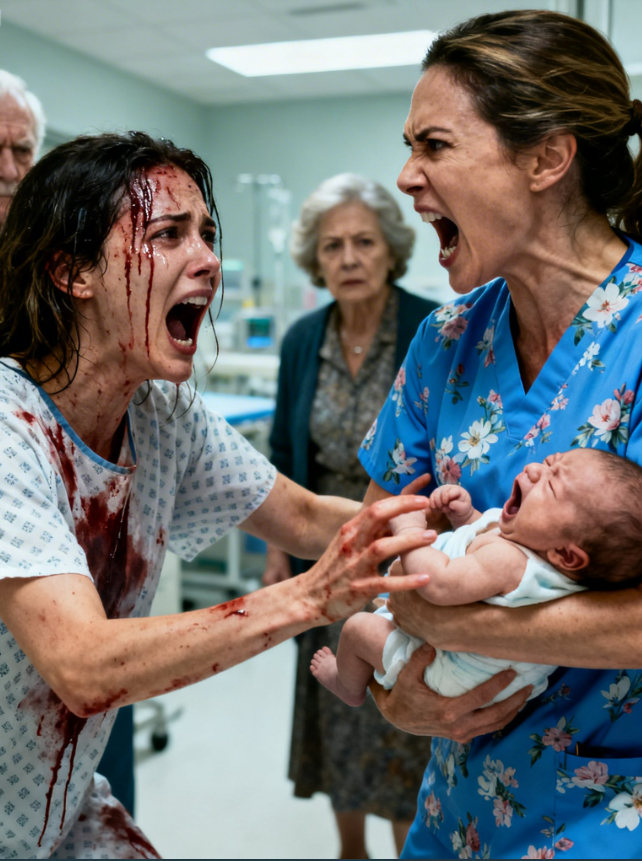
She reached out, hands quick and confident, and ripped my newborn baby out of the nurse’s arms like the baby was a purse and Jenna had decided it belonged to her.
My heart stuttered.
“No!” I tried to sit up, pain tearing through my abdomen like lightning. “Stop—Jenna!”
She didn’t even look at me.
She cradled him against her chest and turned away so her back was to my bed, so I couldn’t see his face—my son’s face—for the first time in his life.
“I’ve got him,” she told the staff, breezy. “I’m taking him to meet the family.”
“The family,” she said, as if I weren’t included.
A nurse stepped in front of her. “Ma’am, hospital policy—”
Jenna’s eyes flashed, and she pulled out a folder from her oversized tote.
“There’s paperwork,” she said. “Emergency guardianship. Her doctor signed off on postpartum mental health risk—she’s not stable.”
My ears rang.
“What?” I whispered.
I tried to focus, tried to understand how my sister had a folder in a delivery room.
The nurse looked uncertain. Another nurse glanced at the papers.
My vision swam.
Jenna tilted her head toward me, and her smile finally sharpened into something ugly.
“You can rest now,” she said. “I’ll handle it.”
Then she walked out of the room with my newborn.
And no one stopped her.
I remember screaming after her. I remember the nurse trying to calm me, telling me to breathe, telling me not to sit up, telling me the baby was safe.
Safe.
The word tasted like a lie.
The world went watery and distant, and the last thing I saw before everything faded was the empty space in the nurse’s arms where my son had been.
When I woke up, it was nighttime.
The room had changed—the lights dimmed, the hallway quieter, my body strapped to exhaustion. A plastic bracelet itched my wrist. My throat was dry, and my stomach felt like someone had scooped me out and shoved me back together wrong.
I turned my head, expecting to see a bassinet.
Expecting to hear a little snuffling breath beside me.
But there was nothing.
Only an empty corner and a bouquet of balloons someone had dropped off—IT’S A BOY!—like a cruel joke.
Panic surged so hard I thought I might rip my IV out.
“Where is my baby?” I rasped.
A nurse came in quickly. “Claire, hey—slow down. Your blood pressure—”
“Where is he?” I repeated, louder. “Where is my son?”
The nurse’s expression shifted into something practiced. “He’s with your sister right now. She said you wanted rest.”
“I never said that,” I said, voice cracking. “Bring him back.”
The nurse hesitated. “Your sister… she gave us some paperwork.”
The word hit me again like a slap.
“Paperwork?” I whispered.
She pointed toward the chart at the end of my bed, as if documents could replace my child.
I tried to push myself up, shaking. “Call security.”
“Claire—”
“CALL SECURITY!”
The nurse finally hurried out. My heart slammed against my ribs. I stared at the door, waiting, shaking so hard the bed rail rattled.
A few minutes later, my mother walked in.
Not a nurse. Not security.
My mother.
Patricia Monroe, dressed in a beige sweater and a look of disappointed patience like I’d forgotten to RSVP to a brunch.
Behind her came my dad, and behind him—Jenna.
Jenna was holding my son.
My son was swaddled in a blue blanket. His tiny face was turned inward against her shoulder so I still couldn’t see him.
I choked on relief and rage at the same time.
“Give him to me,” I said, reaching.
Mom stepped forward fast and put a hand on my forearm like she was restraining a child.
“No,” she said.
I stared at her. “What?”
“Claire,” Mom began, voice calm in that deadly way, “we’ve had a very serious conversation.”
My eyes snapped to Jenna. Jenna’s mouth curved.
Dad didn’t meet my gaze.
“What conversation?” I demanded. “That’s my baby.”
Mom sighed like I was exhausting her. “Honey… you’re not in a place to raise him.”
My stomach dropped. “Excuse me?”
Jenna patted my son’s back, gentle and possessive. “We’re doing what’s best,” she said.
My voice went hoarse. “You stole him.”
Mom’s face hardened. “Don’t say that.”
“I watched her take him,” I said, tears hot. “I watched her walk out of my delivery room.”
Jenna’s eyes narrowed. “You were delirious.”
“I was giving birth,” I shot back. “That doesn’t make me delusional.”
Dad finally spoke, quiet. “Claire… the doctor said you had complications. That you were… unstable.”
I stared at him. “Unstable because I hemorrhaged?”
Mom’s lips tightened. “There’s more.”
Jenna lifted the folder again like a trophy. “Temporary guardianship,” she said. “Signed. Legal.”
“Signed by who?” I snapped.
Jenna’s voice turned syrupy. “You’ll see.”
My chest started to heave. “No. No, this isn’t happening. Give me my baby.”
I tried to swing my legs off the bed, but pain ripped through me and I gasped.
Mom leaned closer and lowered her voice. “Claire, you’re being dramatic. You can’t even sit up.”
“Because I just had surgery,” I spit.
Jenna smiled wider. “Exactly.”
I watched her turn my son slightly, and for the first time I saw his face—tiny, scrunched, perfect. His lips puckered like he was searching for milk. His eyelids fluttered.
My whole body leaned toward him like gravity.
“That’s Liam,” I whispered, almost pleading. “His name is Liam.”
Jenna’s eyes flicked up, amused. “We’ll see.”
Then she rocked him and looked at my mother. “We should go. He needs to eat.”
My hands shook. “I can feed him.”
Mom’s expression didn’t change. “You need to rest.”
I stared at her like she’d become a stranger. “Mom… he’s my child.”
Mom’s gaze slid away. “Jenna will handle it for now.”
“FOR NOW?” I screamed.
The nurse appeared in the doorway, alarmed.
Jenna turned to leave, and my panic snapped into something animal.
“No!” I shouted, voice raw. “Don’t take him—please!”
Dad flinched, but didn’t move.
Mom’s voice hardened. “Claire, stop. You’re upsetting everyone.”
Everyone.
Like the room was worried about comfort and not my baby leaving without me.
I lunged, ignoring pain, grabbing at Jenna’s sleeve. My fingers brushed the blanket around Liam.
Jenna jerked away so fast I nearly fell. Her eyes flashed with pure hatred, just for a second.
“Don’t touch him,” she hissed.
Then she walked out with my son, my family trailing behind her like she was the mother and I was the problem.
The door closed.
The silence after was unbearable.
I lay there shaking, staring at the empty corner where the bassinet should’ve been, listening to my own breathing turn into a sob I couldn’t stop.
By the time I was discharged, Jenna had already done what Jenna did best: she’d controlled the narrative.
My phone was full of texts I didn’t recognize from cousins I barely spoke to.
We heard you’re not doing well.
Jenna is an angel.
You should be grateful.
This is for the baby.
When I called my mother, she didn’t answer.
When I called my dad, it went straight to voicemail.
When I called Jenna, she picked up on the third ring, and her voice was almost cheerful.
“Hi, Claire.”
“Where is Liam?” I asked, trying to keep my voice steady.
A pause. Then: “He’s safe.”
“I’m his mother.”
Another pause, like she was savoring it. “Not right now.”
My hands tightened around the phone. “Let me see him.”
“No.”
“You can’t do this,” I whispered, shock giving way to fury. “You can’t just take my child.”
Jenna laughed softly. “Watch me.”
The line went dead.
I drove to my parents’ house that afternoon, still sore, stitches pulling every time I moved. I parked in the driveway I’d known since I was five, and it felt like I’d arrived at a place I didn’t belong anymore.
The curtains were drawn.
I knocked.
No one answered.
I knocked again, harder, my heart pounding. “Mom! Dad!”
The blinds twitched.
Then my mother’s voice came through the door—flat, cautious.
“Claire, go home.”
“Let me in,” I begged. “I just want to see him. Ten minutes.”
A beat of silence.
Then: “No.”
My throat tightened. “Why?”
“Because Jenna says you’re unpredictable,” Mom replied. “Because she says you’ll cause a scene.”
I stared at the door like it had betrayed me.
“I am not unpredictable,” I said, voice shaking. “I am a mother who wants her baby.”
Mom’s voice dropped lower, colder. “If you keep doing this, we’ll call the police.”
The words knocked the breath out of me.
My own mother threatening me like I was a stranger.
I backed away, hands trembling, tears blurring the porch steps.
That was the day I realized something terrifying:
Jenna didn’t just take Liam.
She took my family with him.
And she made them believe it was love.
For weeks, I lived in a kind of haunted fog.
I pumped breastmilk until my body ached, because my body didn’t get the memo that my baby was gone. I froze bags and labeled them LIAM like the name might summon him back.
I called lawyers with shaky hands. I scrolled through legal websites late at night until the words blurred. I learned phrases I never wanted to learn—temporary guardianship, emergency custody, ex parte orders.
And every time I thought I was close to understanding how Jenna had done it, there was another wall.
The biggest wall was the one Jenna built using one simple tool: my past.
Two years earlier, after my engagement ended, I’d had a short stretch where I couldn’t sleep and cried too often and told my doctor I felt like I was drowning. He’d written “anxiety” in my chart and gave me a low-dose prescription I took for three months.
Jenna knew that.
Jenna used it like a weapon.
Somehow she’d convinced a family friend—someone who worked in legal paperwork—to help her file an emergency petition. She painted me as unstable, alone, “at risk.” She used the fact that Liam’s father wasn’t in the picture, because life isn’t always neat, and my ex had vanished the second responsibility looked real.
She turned my one vulnerable season into a permanent label.
And my family—my mother especially—believed her because believing Jenna was easier than admitting Jenna was cruel.
At first, I tried to fight with volume.
I sent texts. I left voicemails. I showed up at houses. I begged.
Every attempt made Jenna’s story stronger: See? She’s erratic.
So one night, sitting alone in my apartment with a freezer full of milk I couldn’t deliver, I made a decision.
If Jenna wanted to win with a story, I would win with the truth.
Not yelled.
Not begged.
Documented.
I opened a storage bin and pulled out everything I’d saved since I found out I was pregnant: ultrasound photos, the tiny knit hat I’d bought at Target because I couldn’t help it, the little onesie that said Mommy’s Best Friend.
I laid them on my kitchen table.
Then I printed every message.
Every text where my mom said, I’m so excited to meet my grandson.
Every voicemail where my dad joked about teaching Liam baseball.
Every email from Jenna offering to “help” so she could get close.
I printed my medical records, too—the real ones. The postpartum notes. The hemorrhage report. The nurse’s chart.
I printed the discharge summary that said I was alert, oriented, appropriate.
I took pictures of the milk bags lined up like soldiers in my freezer.
I wrote down the timeline in black ink, date by date, hour by hour, because Jenna couldn’t twist facts if they were nailed to paper.
Then I went to a craft store and bought a thick, leather-bound album with blank pages.
A memory book.
It felt ridiculous at first—something people made for scrapbooking nights and Pinterest boards.
But I wasn’t making a cute baby keepsake.
I was building a record.
A witness.
On the first page, I taped a photo of the ultrasound where Liam looked like a little astronaut floating in grainy gray.
Under it, I wrote:
HI, LIAM.
IF YOU’RE READING THIS ONE DAY, I NEED YOU TO KNOW I NEVER LET GO.
I wrote about feeling him kick for the first time while I was standing in line at a Dunkin’ Donuts. I wrote about how I cried in my car afterward, laughing because I’d never felt so scared and so happy at the same time.
I wrote about choosing his name, Liam James, because it sounded strong and kind.
I wrote about the day Jenna moved from “supportive aunt” to predator in my delivery room.
I didn’t call her names. I didn’t dramatize it.
I wrote it like a police report, because the truth doesn’t need glitter.
SHE TOOK YOU FROM MY ARMS.
SHE SAID I WASN’T STABLE.
SHE LEFT THE ROOM WITH YOU.
NO ONE STOPPED HER.
I included copies of texts where Jenna told me, weeks before I gave birth, You’re lucky you have me. You’d fall apart without me.
I included the screenshot of my mother telling me she’d call the police if I came to the house again.
Every page was a brick.
By the time I finished, the book was heavy.
So was my heart.
I put it in a box and addressed it carefully:
LIAM MONROE
c/o Jenna Monroe
Then I went to the post office and sent it certified mail, signature required.
My hands didn’t shake when I handed it over.
Because for the first time since my son was taken, I wasn’t begging.
I was speaking.
And paper doesn’t stutter.
For a while, nothing happened.
Weeks passed.
Then months.
My lawyer filed motions. Jenna’s lawyer delayed. Hearings got rescheduled. Family court moved at the pace of molasses and misery.
I didn’t see Liam.
Not once.
But sometimes—late at night—my phone would buzz, and my heart would leap like a fool.
At first it was just silence: a call where no one spoke.
Then, one evening, an email came from my dad.
Subject line: I READ IT.
I stared at the screen until my vision blurred.
The email was short.
Claire,
I read the book. I didn’t know. I swear I didn’t know. Your mom is furious at me for even opening it, but I couldn’t stop. I’m so sorry. I’m so sorry.
My hands covered my mouth. A sob slipped out, half relief, half rage.
Because he hadn’t known. He’d just obeyed.
And now he’d finally seen Jenna’s fingerprints all over the truth.
After that, the family began to crack—not all at once, not in some dramatic movie way.
More like hairline fractures spreading.
My aunt stopped posting supportive comments under Jenna’s social media photos.
My cousin messaged me privately: I thought you abandoned him. Jenna told us you signed him over.
My mother, still loyal to Jenna, doubled down harder, calling me manipulative, accusing me of “turning everyone against family.”
But the book kept doing what I made it to do.
It existed.
It sat on a coffee table. It got opened. It got passed hand to hand.
It didn’t raise its voice.
It didn’t need to.
And then, about a year after Liam was born, Jenna made a mistake.
Not the kind that comes from a guilty conscience.
The kind that comes from entitlement.
She tried to enroll Liam in daycare using my name as “mother” on a form, because paperwork is inconvenient when you’re pretending to be someone else.
A daycare employee—someone who knew my cousin—asked questions. The questions led to a call. The call led to my lawyer. My lawyer pounced.
Suddenly, Jenna wasn’t just the hero aunt. She was someone using fraud to cover a lie.
The next court date came fast.
Jenna arrived in a tailored suit, holding Liam on her hip like a prop. He was eighteen months old now—toddler cheeks, curls at his temples, eyes that looked like mine.
I hadn’t held him since he was born.
My arms ached with the ghost of it.
When the judge asked Jenna why she hadn’t allowed supervised visitation once my health cleared, Jenna did what she always did: she smiled and performed.
“She’s unstable,” Jenna said. “It wouldn’t be safe.”
My lawyer slid the memory book across the table like a bomb.
Not the physical book—the copies, the receipts, the timeline, the certified mail signature Jenna had scrawled when she accepted it.
“The petitioner has documented,” my lawyer said evenly, “that Ms. Monroe’s claims were based on misrepresentation and that the child’s mother has been medically cleared since discharge.”
Jenna’s smile tightened.
The judge’s eyes narrowed as he flipped through pages.
My heart pounded so hard it hurt.
Then the judge looked up and said words I will never forget:
“Ms. Monroe, this court does not take kindly to interference with parental rights.”
Jenna’s face changed for the first time—real fear flashing through her perfect mask.
The judge ordered immediate supervised visitation.
My first visit was in a bland county office with plastic chairs and a woman with a clipboard.
Liam toddled toward me hesitantly, staring like he was trying to place me.
My knees almost gave out.
“Hi,” I whispered, voice shaking. “Hi, buddy.”
He blinked, then reached for the pen in the supervisor’s hand instead, like toddlers do.
I laughed through tears.
That laugh—my laugh—felt like coming back to life.
Eighteen months after Jenna ripped my newborn out of my arms, there was a knock on my door.
It was a Saturday, chilly and bright. I was making grilled cheese because Liam had started visiting more often, and today—miracle of miracles—he was with me for a full afternoon.
He sat in a booster seat at my kitchen table, banging a spoon and humming to himself.
When I heard the knock, my body went rigid.
I knew the rhythm.
Three taps, impatient, like the door owed someone access.
I wiped my hands on a towel and walked to the entryway with my heart beating in my throat.
Through the peephole, I saw Jenna.
She looked… different.
Not messy. Jenna never looked messy.
But thinner. Tighter. Like sleep had stopped visiting her.
I opened the door only as far as the chain allowed.
“What do you want?” I asked.
Jenna’s eyes flicked past me, toward the sound of Liam humming in the kitchen.
Her throat bobbed. “I—can we talk?”
I didn’t move. “You have thirty seconds.”
Jenna let out a breath like it hurt. “Claire… this has gotten out of control.”
I stared at her. “You mean you got caught.”
Her jaw tightened. “I mean the court is being unfair.”
I laughed once, sharp. “Unfair.”
Jenna lifted her hands, palms out, like she was calming a wild animal. “Okay. Fine. Look. I’m not here to fight.”
I didn’t believe her for a second.
But then she said the thing that made my stomach turn.
“I was thinking,” she began, voice careful, “maybe we can… share him.”
I blinked. “Share him.”
“Like… co-parenting,” she rushed on. “He loves me. I raised him. You can’t just rip me out of his life.”
The audacity nearly stole my breath.
“You raised him,” I repeated slowly, “because you stole him.”
Jenna’s eyes flashed. “I saved him.”
The words hit like a slap.
I stepped closer to the door, chain rattling. “From what? From a mother who gave birth to him? From a woman who hemorrhaged and still begged to hold her child?”
Jenna’s lips trembled—anger or fear, hard to tell. “You were a mess, Claire. You always are. You fall apart and expect everyone to clean it up.”
I stared at her, suddenly calm.
Because I finally saw the truth clearly:
Jenna didn’t want Liam because she loved him.
She wanted him because he proved she could take whatever she wanted and call it care.
I leaned in, voice low and steady. “You don’t get to rewrite this.”
Jenna swallowed. “Claire—please. I’m—” Her eyes flicked away, then back. “Mom’s not doing well. The family is splitting. This is tearing everything apart.”
I held her gaze. “You tore it apart.”
Her face tightened. “So what, you’re just going to take him and pretend I don’t exist?”
“I’m going to be his mother,” I said. “The one you tried to erase.”
Jenna’s eyes darted again toward the kitchen. Liam laughed at something—probably the squeak of his spoon on the table.
Jenna’s voice broke, just slightly. “He calls me Mama sometimes.”
Something in me went cold.
“That’s not because he chose you,” I said, each word deliberate. “It’s because you trained him.”
Jenna’s cheeks flushed. “Don’t—”
I raised my hand, stopping her. “Listen. You want to be in his life?”
Jenna’s face softened like she’d spotted an opening. “Yes.”
“Then you will follow the court order,” I said. “You will show up to supervised visits when the judge says. You will stop telling people lies. And you will never—ever—refer to yourself as his mother again.”
Jenna’s jaw clenched. “That’s humiliating.”
I didn’t blink. “That’s reality.”
Her eyes narrowed. “You’re punishing me.”
I shook my head, almost sadly. “I’m protecting him.”
Jenna’s voice turned sharp. “You can’t keep him from me.”
I leaned closer, chain still between us, and my voice dropped into something that made her still.
“I can’t control what you want,” I said. “But I can control what I allow. And I will never allow you to steal from us again.”
For a moment, Jenna looked like she might explode.
Then she did something I never expected.
She sagged.
Like the fight drained out of her all at once.
“I didn’t think you’d survive without him,” she whispered.
The words landed heavy, not as an insult, but as a confession.
She hadn’t expected me to keep going.
She’d expected me to disappear.
I stared at her, feeling something strange—no pity, not quite satisfaction, just clarity.
“I didn’t survive,” I said quietly. “Not at first. I crawled. I broke. I rebuilt. And I did it all with an empty cradle.”
Jenna’s eyes shimmered, but her pride held her face stiff.
Then I heard little footsteps behind me.
Liam toddled into the hallway, clutching his sippy cup, looking up at me with wide eyes.
“Hi,” he said, one of the few words he could say clearly.
My heart cracked open.
I turned my body instinctively, blocking Jenna’s view.
Jenna craned her neck anyway.
“Liam,” she whispered, voice aching, like she had a right to say it.
Liam stared at the door, curious but not reaching.
He didn’t know her from here.
Not anymore.
And Jenna saw that.
Her face twisted in something like panic.
“You’re turning him against me,” she accused, voice rising.
I didn’t raise my voice back.
I crouched beside Liam and smoothed his hair. “Hey, buddy,” I murmured. “Go back to the table. Your grilled cheese is almost ready.”
He nodded solemnly and waddled away.
Then I stood, facing Jenna again.
“The truth spoke for itself,” I said. “That’s why you’re here.”
Jenna’s lips pressed together, trembling.
She wanted to argue. To claw her way back into control.
But the last eighteen months had changed something: my silence was gone.
“You don’t get to share him like he’s a timeshare,” I continued. “He’s a person. And he’s my son.”
Jenna’s eyes flashed one last time. “So that’s it?”
“That’s it,” I said.
I reached up and unhooked the chain—not to let her in, but to end it cleanly.
I opened the door fully, stepped onto the porch, and pointed down the walkway.
“You can talk to your lawyer,” I said. “You can follow the judge’s order. And if you ever come here again outside of that—if you ever try to take him again—I will call the police so fast your head will spin.”
Jenna stared at me like she didn’t recognize me.
Good.
Because I didn’t recognize the woman I used to be either—the one who begged at locked doors.
Jenna’s throat bobbed. She looked past me one more time, toward my home, toward my son’s laugh drifting faintly from the kitchen.
Then she nodded once, stiff.
And she walked away.
I watched her until she reached her car.
When she drove off, I stood on the porch for a long moment, breathing in cold air like it was medicine.
Then I went back inside.
Liam was in his chair, tapping the table, waiting.
I placed the grilled cheese in front of him, cut into squares.
He squealed like it was the best thing he’d ever seen.
I smiled, kneeling beside him, and pressed a kiss to his soft cheek.
No one could erase me anymore.
Not with lies.
Not with paperwork.
Not with my own family standing on the wrong side.
Because the truth had already done what it always does, eventually:
It found daylight.
And it brought my son home.
THE END
Để lại một phản hồi