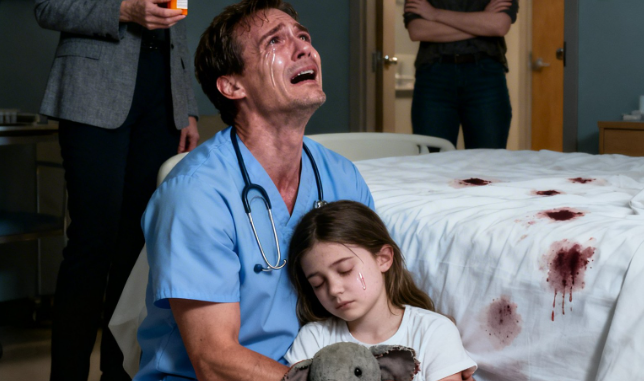
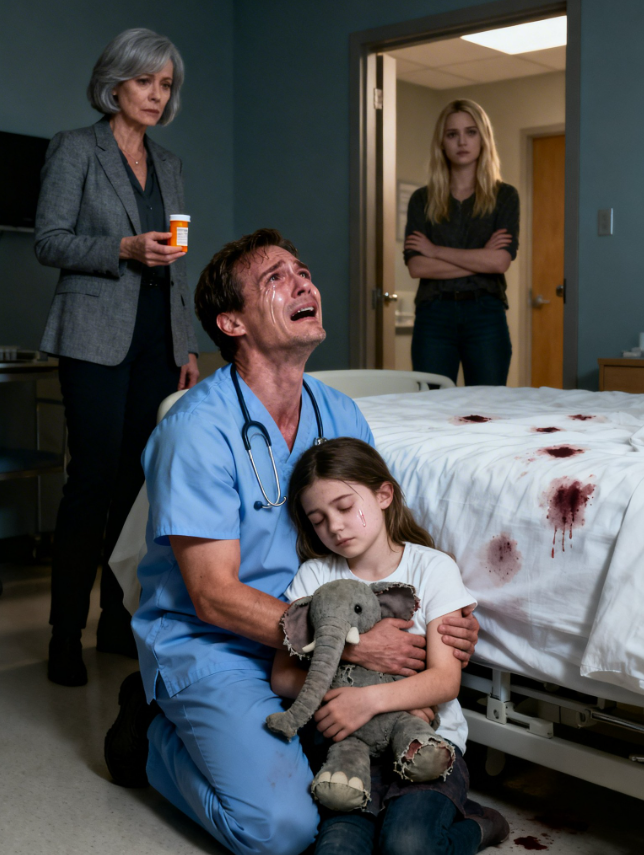
After My 18-Hour Shift, I Found My Daughter Unresponsive—The Paramedic’s Report Exposed My Family’s Cruel Secret
When I finally pulled into my driveway, the sky was the color of dirty cotton—gray, heavy, exhausted, just like me.
Eighteen hours on my feet at St. Anne’s Medical had left my scrubs smelling faintly of antiseptic and stale coffee. My hair was pinned up in the same messy knot it had been in since 5 a.m., and my whole body buzzed with that wired fatigue that makes you feel like you’re walking through water.
All I could think about was my daughter.
Ellie.
Eight years old. All elbows and questions. The kind of kid who could turn a cardboard box into a spaceship and a Tuesday into a holiday if you gave her twenty minutes and a pack of markers.
I pictured her asleep on the couch like she always was when I worked late, a blanket pulled up to her chin, her cheek squished against a throw pillow. I pictured the faint snore she had when she got really comfortable. I pictured the relief of seeing her safe.
My mother, Janice, had insisted I stop paying the sitter months ago.
“Why throw money away?” she’d said, tapping her manicured nails on my kitchen counter like she was sealing a deal. “I’m right here. I raised you, didn’t I?”
I should’ve heard the warning buried inside that sentence.
I should’ve noticed how she said raised you like it was a debt I still owed.
My sister, Brielle, had moved back home too—“temporarily,” she’d claimed. It had been six months. She slept until noon, rolled her eyes at everything, and treated my house like a free Airbnb with a built-in punching bag.
But tonight, all of that faded behind one need: see Ellie. Touch her hair. Hear her breathe. Tell my nervous system it could unclench.
I turned off the engine and just sat there for a second, forehead resting against the steering wheel.
“Just get inside,” I whispered to myself.
I unlocked the front door and stepped into the quiet.
The living room lamp was on. The TV was muted, a late-night talk show flickering in blues and purples. Empty snack wrappers sat on the coffee table like tiny flags of neglect.
Ellie was on the couch, curled on her side beneath her unicorn blanket.
For one perfect second, relief flooded me. She looked peaceful—hair fanned across the pillow, one small hand tucked under her cheek.
I tiptoed over, careful not to wake her. I brushed my knuckles along her forehead.
Warm.
Breathing.
Okay.
In the kitchen, I found my mother sitting at the table with a glass of wine, scrolling through her phone like nothing in the world had ever gone wrong. She wore a silky robe I’d never seen before, lipstick still perfect. My sister lounged on a barstool, eating cereal out of the box.
“You’re home late,” Janice said without looking up.
“I worked a double,” I murmured, too tired to bite. I opened the fridge and grabbed a bottle of water with shaky hands. “How was Ellie?”
Janice made a small sound—half sigh, half dismissal. “Fine.”
Brielle snorted. “Your kid’s exhausting.”
I clenched my jaw, took a long drink of water, and forced myself not to respond. Ellie was asleep. That was what mattered.
“I’m going to shower,” I said. “Try to keep it down.”
Janice finally looked at me, eyes sweeping over my scrubs. “You can’t keep living like this,” she said, like she was the one carrying the weight. “You’re never here. That child needs structure.”
I almost laughed. Almost.
“Goodnight, Mom,” I said, and walked away before my exhaustion turned into words I couldn’t take back.
Upstairs, I showered in lukewarm water because I couldn’t wait for the hot to kick in. I washed my hair twice and still felt like the hospital smell was stuck to my skin. When I pulled on an old T-shirt and sweatpants, my legs trembled with fatigue.
I checked my phone—three missed calls from an unknown number. A voicemail from work. A text from a coworker asking if I could cover tomorrow.
I stared at the screen and felt something inside me harden.
No. Not tomorrow. Tomorrow belonged to Ellie. Tomorrow I’d make pancakes, and we’d watch cartoons, and we’d pretend the world didn’t run on burnout.
I padded downstairs again, moving slower now, sleep tugging at me like gravity.
Ellie was still on the couch. Same position. Same blanket. Same soft, quiet stillness.
I smiled without meaning to. “There’s my girl,” I whispered.
I didn’t want to wake her—she deserved sleep—but she’d probably be uncomfortable on the couch. I figured I’d carry her upstairs like I used to when she was smaller. She’d always wake for a second, wrap her arms around my neck, and then melt back into sleep.
I leaned down, slid my hands under her shoulders.
“Ellie,” I murmured. “Sweetheart. Let’s go to bed.”
Nothing.
I tried again, a little louder. “Ellie?”
Still nothing.
A tiny pulse of unease pricked the back of my neck. Some kids sleep hard. Ellie slept hard. Especially when she’d had a big day.
I brushed her hair back from her face. “Hey, baby. Wake up.”
Her eyelids didn’t flutter. Her mouth didn’t shift. Her fingers didn’t twitch.
The unease sharpened.
“Ellie,” I said, and my voice changed without my permission. It turned from gentle to tight. “Ellie, wake up.”
I shook her shoulder lightly—then again, harder.
Her head lolled slightly against the pillow.
My heart slammed into my ribs.
No. No, no, no.
I pressed my fingers to her neck. Felt for her pulse.
It was there—faint, slower than it should’ve been. Her skin was warm, but not flushed. Her lips looked… wrong. A little pale. A little dry.
I leaned close to her mouth.
Her breaths were shallow. Too shallow.
Panic hit like a wave, cold and immediate.
“Ellie!” I snapped, shaking her now with real force. “Ellie, come on—wake up!”
Nothing.
My hands were trembling so badly I could barely keep hold of her shoulder.
I turned toward the kitchen and screamed, “Mom!”
Janice appeared in the doorway, annoyed. “What?”
“Did you give Ellie anything?” I demanded, voice cracking. “Did you give her medicine? Did she hit her head? What happened?”
Janice blinked slowly, as if I was the one being dramatic. “She was being annoying,” she said. “So I gave her a couple pills to shut her up.”
The words didn’t register right away. My brain tried to reject them.
“A couple… what?” I whispered.
Brielle leaned into view behind her, chewing. “Relax,” she said, as if I’d asked for extra napkins. “She’ll probably wake up.”
I took a step closer, vision tunneling. “What pills?”
Janice waved a hand. “One of mine. A little something for nerves. She wouldn’t stop whining. You can’t spoil a child every time she wants attention.”
I felt like my blood had turned to ice.
“You gave my eight-year-old your prescription pills?” I choked out.
Janice’s mouth tightened. “Don’t talk to me like I’m a criminal. I was helping you. You’re always gone. I’m the one stuck dealing with her moods.”
Brielle’s lips curled into something ugly. “She’ll probably wake up,” she repeated, then shrugged. “And if she doesn’t… then finally, we’ll have some peace.”
I stared at my sister like I’d never seen her before.
Like she’d opened her mouth and let something rotten crawl out.
My hands clenched into fists so tight my nails bit skin.
I didn’t have time for rage. I didn’t have time for screaming.
I had time for one thing.
Ellie.
I snatched my phone from my pocket and dialed 911 with shaking fingers.
The operator answered, and my voice came out strangely calm—clinical, like I was back in triage.
“My daughter is unresponsive,” I said. “She’s breathing but shallow. My mother gave her prescription pills. She’s eight.”
“Is she awake at all?” the operator asked.
“No,” I said, kneeling beside Ellie again. “She won’t respond.”
“Stay on the line,” the operator said, and I heard keyboard clicks. “Help is on the way. Do you know what medication she was given?”
I looked up at Janice. “What did you give her?” I demanded.
Janice hesitated, suddenly less smug. “It was just—just my anxiety medication.”
“What is it called?” I barked.
Brielle rolled her eyes. “Oh my God.”
Janice sighed dramatically, like I was inconveniencing her. “It’s… it’s something the doctor prescribed. It’s not poison.”
“Name,” I snapped.
She finally muttered it.
I repeated the name to the operator, then added, “I don’t know how much.”
The operator’s voice sharpened. “Okay. Do not give her food or water. Do not try to make her vomit. Lay her on her side if she vomits. Is she breathing?”
“Yes,” I said, watching Ellie’s chest. “But shallow.”
“Help is coming,” the operator said. “Stay with her.”
I hung up and stared at my mother.
“I told you not to give her anything without asking me,” I said, voice shaking with fury. “I told you.”
Janice lifted her chin. “Maybe if you were home like a real mother—”
I didn’t let her finish.
I scooped Ellie’s small body into my arms and carried her to the front porch, because something in me needed air, needed space, needed the universe to understand we were in danger.
Ellie’s head lolled against my shoulder.
Her weight felt wrong—too heavy for her size, like her muscles had turned to sand.
I sat on the porch steps, holding her tight, rocking slightly without meaning to.
“Stay with me,” I whispered into her hair. “Ellie, baby, stay with me. Please.”
Minutes stretched like hours.
Then the wail of a siren cut through the night.
Red and blue lights flashed across the houses. An ambulance pulled up, followed by a police cruiser. Two paramedics jumped out—one woman, one man—moving fast but focused.
“Mom?” the female paramedic called. “Where is she?”
I stood, clutching Ellie. “Here,” I said. “She’s not responding. She’s breathing but shallow. My mother gave her prescription medication.”
The male paramedic’s face tightened. He took Ellie gently from my arms and laid her on the stretcher. The female paramedic was already applying monitors, checking her pupils, checking her airway.
“What medication?” she asked.
I told her the name again. She exchanged a glance with her partner.
“And how much?” she pressed.
“I don’t know,” I admitted, voice breaking. “My mother said ‘a couple pills.’”
The paramedic’s mouth hardened. “Okay,” she said, brisk. “We’re going to support her breathing and get her to the hospital.”
The police officer stepped onto my porch. “Ma’am,” he said, looking at me, “can you tell me what happened?”
I pointed at the open door. “My mother is inside,” I said. “She admitted she gave my daughter pills to make her quiet. My sister said—” my voice cracked “—my sister said she hoped Ellie wouldn’t wake up.”
The officer’s expression turned grim. He stepped past me toward the doorway.
Inside, I heard Janice’s voice rising in indignation.
“I was helping!” she insisted. “You can’t arrest someone for helping!”
I followed the stretcher to the ambulance, moving like my legs didn’t belong to me.
The male paramedic climbed in with Ellie. The female paramedic turned to me. “Are you coming?”
“Yes,” I said. “Yes, I’m her mother.”
She nodded and helped me in.
The ambulance doors slammed shut, and the world narrowed to flashing lights and the sound of Ellie’s shallow breaths.
I sat on the bench seat, hands clasped so tight they hurt, watching the paramedics work.
The female paramedic spoke into a radio. The male paramedic adjusted oxygen. He checked Ellie’s vitals again and again, his jaw tense.
“Come on, sweetheart,” he murmured, not unkindly. “Hang on.”
I couldn’t breathe.
My mind kept replaying Janice’s words like a broken recording.
I gave her a couple pills to shut her up.
Like my daughter was a barking dog.
Like her voice was something to silence.
The ambulance hit a bump, and Ellie’s head shifted slightly. Her eyelids fluttered for a second—barely—then stilled again.
I leaned forward instinctively.
“Ellie,” I whispered. “It’s Mommy. I’m here.”
She didn’t respond.
At the hospital, everything moved fast.
The doors burst open, and we rolled through bright hallways into the ER. A team was waiting, because paramedics don’t bring in an unresponsive child without calling ahead.
Someone asked me questions rapid-fire: name, age, weight, allergies, medical history.
I answered like a machine, because if I stopped functioning, I’d collapse.
Ellie was whisked behind curtains. Monitors beeped. A doctor approached me—a pediatric ER physician I recognized from my own shifts, Dr. Shelton. His face was serious.
“Lauren,” he said, voice low, “we’re going to do everything we can. We need to run labs and a tox screen. Do you know exactly what she ingested?”
“My mother gave her prescription pills,” I said, and the words tasted like poison. “I don’t know how many.”
His eyes hardened. “Okay,” he said. “We’ll treat what we see. We’ve already notified social work and police. You did the right thing calling.”
I nodded, but my hands were shaking again.
In the waiting area just outside the pediatric bay, a social worker arrived—a woman named Marisol with kind eyes and a clipboard that looked too small to hold what was happening.
“Lauren,” she said, touching my arm gently, “I’m so sorry. We’re going to talk, okay? But first I need to know: is your mother a regular caregiver for Ellie?”
I swallowed hard. “Yes,” I whispered. “When I work late.”
Marisol’s expression softened, but there was steel underneath it. “Okay,” she said. “We’re going to make sure Ellie is safe.”
A police detective arrived too, introducing himself as Detective Grady. He was calm, professional, the kind of man who had seen horror and learned to pack it away neatly.
“We’re speaking with your mother and sister now,” he told me. “They were still at your house when we arrived.”
My throat tightened. “Did they try to leave?”
He hesitated. “Your sister did,” he said. “She said she was ‘going out for air.’ The officer asked her to stay.”
I stared at him. “My mother admitted it,” I said. “She said she gave Ellie pills. She said it like it was normal.”
Detective Grady nodded slowly. “We’ll document everything,” he said.
Time turned strange after that. It stretched and snapped. I sat in a stiff chair, staring at a blank wall, listening to the distant sound of monitors, waiting for someone to tell me my daughter was going to wake up.
When Dr. Shelton returned, his expression was different.
Not panicked.
But heavy.
“Lauren,” he said quietly, “can we talk somewhere private?”
A cold dread rolled through me.
He led me into a small consultation room. Marisol and Detective Grady followed, closing the door behind them.
My hands started shaking again before anyone even spoke.
“What?” I whispered. “What’s happening? Is she—”
“She’s alive,” Dr. Shelton said quickly. “She’s stable right now. We had to support her breathing, but she’s responding to treatment.”
My knees nearly buckled with relief.
Then he continued.
“The tox screen came back.”
My relief turned to ice again.
Dr. Shelton held a page in his hand—printed lab results. Numbers and names that looked like a foreign language to anyone else, but to me—because I worked in this world—they looked like a verdict.
“Your daughter has significant levels of a sedative in her system,” he said carefully. “Not prescribed to her. High enough to suppress her breathing.”
I swallowed hard, words stuck in my throat.
“And,” he continued, “there’s another substance present.”
My stomach dropped. “Another… what?”
He exhaled slowly. “A pain medication. Also not prescribed to her.”
The room tilted.
Janice. She hadn’t said anything about a second medication.
Dr. Shelton’s voice was steady but grim. “The combination is what made this so dangerous,” he said. “It’s why her breathing was so shallow. It could have been fatal.”
I stared at the report, my vision blurring.
Marisol spoke softly. “Lauren, I need you to hear this,” she said. “These medications don’t appear accidentally in a child’s body. This is serious.”
Detective Grady leaned forward. “Did your mother have access to pain medication?” he asked.
I couldn’t answer. My throat closed up.
Because the truth hit me in a flash—Janice had been complaining for months about her “back pain.” I’d seen pill bottles in her purse sometimes. She’d always snapped them shut when I walked into the room.
“She said it was just anxiety pills,” I whispered, voice shaking. “She said it like—like it was nothing.”
Dr. Shelton hesitated, then added the part that stole the rest of my breath.
“There’s something else,” he said.
I looked up at him, terrified.
He tapped the paper gently. “The lab suggests… this may not be the first exposure.”
I froze.
My ears rang. “What do you mean?”
He chose his words carefully. “We see indicators that your daughter’s body has metabolized similar substances before,” he said. “Not definitive by itself, but combined with her presentation… it raises concerns about repeated administration.”
For a moment, I couldn’t speak.
I couldn’t even think.
All I could see was Ellie on the couch, sleeping too still. All I could hear was Brielle’s voice—if she doesn’t, then finally we’ll have some peace.
I felt like I was looking at my family for the first time, and the picture was warped beyond recognition.
Detective Grady’s voice cut in, firm. “Lauren,” he said, “we’re going to investigate. But right now, we need to know if you’ve ever noticed your daughter unusually sleepy after being with your mother.”
My mind flickered back through weeks—Ellie dozing off early, Ellie taking “naps” she’d outgrown, Ellie complaining sometimes that she felt “weird” or “heavy.” I’d blamed my schedule. I’d blamed too much screen time. I’d blamed the stress of a divorce.
I’d never blamed my mother.
“I—” My voice broke. “Sometimes she’s been tired. But I thought… I thought it was just—”
Marisol’s eyes filled with sympathy. “You trusted your mother,” she said gently. “That’s not your fault. But now we have to protect Ellie.”
Protect.
The word grounded me. It snapped me back into motion.
“I want to see her,” I said, wiping my face hard with my sleeve. “I need to see her.”
Dr. Shelton nodded and opened the door.
Ellie lay in the pediatric bay with an oxygen mask and an IV line in her small arm. Her face was pale, but her chest rose more steadily now. Monitors beeped with rhythmic insistence.
I moved to her bedside like a magnet pulled to metal.
“Hi, baby,” I whispered, taking her hand carefully. “Mommy’s here.”
Her fingers didn’t squeeze back, but they were warm.
Dr. Shelton spoke quietly behind me. “She may be groggy for a while,” he said. “We’re watching her closely.”
Detective Grady stepped closer. “Your mother and sister are being interviewed right now,” he said. “Given the lab results, there may be charges.”
Charges.
Against my mother.
Against my sister.
The words felt impossible, like trying to picture the sun turning off.
But then Ellie made a small sound—barely a whimper—and my heart clenched.
I looked down at her, tears spilling again.
“Hey,” I whispered urgently. “Ellie. Sweetheart. Can you hear me?”
Her eyelids fluttered, slow and heavy.
For a second, her eyes opened—glassy, unfocused.
She looked at me like she was trying to find me through fog.
“Mom?” she whispered, the word slurred.
“Yes,” I choked out. “Yes, baby. I’m here.”
Her mouth trembled. “I’m… sleepy.”
“I know,” I said, brushing her hair back. “You’re safe. You’re safe now.”
Her eyes drifted shut again. “Grandma… gave me… ‘quiet candy,’” she mumbled, barely audible.
Every muscle in my body went rigid.
Detective Grady’s eyes sharpened. “Lauren,” he said softly, “did you hear that?”
I nodded, unable to speak.
My mother had a name for it.
Quiet candy.
Like it was a trick. Like it was a tool. Like my daughter’s voice was something to erase.
Dr. Shelton’s jaw tightened. Marisol’s face went pale.
Detective Grady stepped back, already pulling out his phone.
The next hours were a blur of paperwork and whispered conversations. Hospital security escorted my mother into the building at one point—police had brought her for questioning again, and she was furious.
I saw her through a glass window in the hallway, sitting in a chair with her arms crossed, looking more insulted than afraid.
When she spotted me, her lips curled.
“Lauren!” she snapped, loud enough that nurses turned. “This is ridiculous. She’s fine. They’re acting like I tried to kill her!”
Something in me broke cleanly, like a branch snapping under pressure.
I walked toward the glass, hands trembling—not with fear now, but with rage held in a tight, controlled grip.
“You could have,” I said, voice low and shaking. “Do you understand that? She could be dead.”
Janice scoffed. “Oh please,” she said. “You’re dramatic, just like your daughter.”
Brielle appeared behind her, lounging against the wall even in a police station posture, her face bored. When she saw me, she smirked.
“Still playing hero?” she asked.
I stared at my sister, disgust churning in my stomach. “You said you’d have peace if she didn’t wake up,” I said. “You said it like you were talking about taking out the trash.”
Brielle shrugged. “I was joking.”
“No,” I said. “You weren’t.”
Janice leaned forward, eyes sharp. “If you were home more,” she hissed, “none of this would’ve happened.”
That was the moment I stopped seeing her as my mother.
Mothers don’t blame you for their cruelty.
Mothers don’t drug children because they’re “annoying.”
Mothers don’t call a child’s voice a problem to be solved.
Detective Grady approached from behind me. “Ma’am,” he said to Janice through the glass, “you’re being detained pending further investigation.”
Janice’s expression changed—finally. Not fear, exactly. More like disbelief that the world wasn’t bending for her.
“You can’t,” she snapped. “I know people.”
There it was. The same kind of line bullies always use, whether they’re in a playground or a courtroom.
Detective Grady didn’t blink. “We have medical documentation,” he said. “And we have statements. You’ll speak with your attorney.”
Janice turned her glare on me, and for the first time, I felt it clearly: hatred.
Not disappointment. Not anger.
Hatred.
“You did this,” she spat. “You always wanted to make me the villain.”
I stared back, voice trembling but steady. “No,” I said. “You did this. To my child.”
That night, Ellie was admitted for observation. I sat by her bed with my head resting near her hand, refusing to leave.
Marisol returned with paperwork about safety plans. “Lauren,” she said gently, “I need to ask: do you feel safe going home?”
I thought about my front door. The kitchen. The couch where Ellie had almost stopped breathing.
“No,” I whispered.
She nodded. “Then we’ll help you figure out a safe place for tonight,” she said. “And there will likely be a protective order.”
Protective order.
Against my mother.
Against my sister.
The words still didn’t feel real, but they were becoming my reality.
The next morning, Ellie woke fully for the first time.
Her eyes were clearer. Her voice was small but steady.
“Mom,” she whispered.
I leaned in fast. “Hey, baby,” I said, smiling through tears. “How do you feel?”
She frowned, as if searching for a word. “Like… like my head is full of cotton,” she said.
“That makes sense,” I said softly. “But you’re getting better.”
She looked around the hospital room, then back at me. “Did Grandma get mad?” she asked, fear flickering.
My throat tightened. “No,” I said, choosing truth carefully. “Grandma did something wrong, and the doctors are making sure you’re okay. And I’m making sure you’re safe.”
Ellie swallowed. “She said I talk too much,” she whispered.
Anger flared hot in my chest.
“You don’t talk too much,” I said firmly. “You’re a kid. Kids talk. That’s normal. That’s good.”
Ellie’s eyes filled slightly. “She said if I didn’t stop, I’d go to sleep forever.”
My breath caught.
I pressed my forehead to Ellie’s hand for a second, shaking.
“No,” I whispered fiercely. “No, baby. You’re not going anywhere. Not ever.”
Detective Grady and an assistant prosecutor met with me later that day. They asked me about my mother’s medications, whether she’d ever joked about “quieting” Ellie, whether I’d noticed changes before.
I answered everything, nausea twisting through me with every memory that suddenly looked different.
The prosecutor, Dana McBride, was blunt. “Lauren,” she said, “based on the evidence, your mother is likely facing felony charges for child endangerment. Possibly more, depending on intent.”
Intent.
I thought about “quiet candy.” I thought about Brielle’s smirk.
“I want them away from her,” I said, voice shaking. “Forever.”
Dana nodded. “We’ll pursue that,” she said. “But I also need you prepared: families fight back. They’ll claim you’re overreacting. They’ll claim it was an accident.”
“It wasn’t,” I said, the words coming out like a vow. “It wasn’t an accident.”
Two days later, the official report arrived—typed, stamped, coldly objective.
A toxicology summary. A physician’s note. A risk assessment.
I sat in a small hospital consultation room with Dr. Shelton as he walked me through it, line by line.
The numbers on the page weren’t just numbers. They were proof.
“Lauren,” he said gently, “this level of sedation… it wasn’t mild. It wasn’t a ‘mistake’ like giving a kid the wrong cough syrup.”
My hands trembled as I held the paper.
“And,” he added softly, “the report notes concern for prior exposure. Again, it doesn’t stand alone. But it fits with the disclosure your daughter made.”
I stared at the words until they blurred.
My mouth went dry. “So… this might’ve happened before,” I whispered.
Dr. Shelton didn’t sugarcoat it. “It’s possible,” he said. “And that’s why the investigation matters.”
Speechless didn’t even begin to describe it.
I felt hollowed out. Like someone had reached into my chest and scooped out the part that believed love automatically meant safety.
Because I had trusted my mother with my daughter.
And my mother had used that trust like a weapon.
When Ellie was discharged, the hospital wouldn’t release her until a safety plan was in place. Marisol coordinated with CPS for a home check and a temporary order barring Janice and Brielle from contact.
Janice and Brielle couldn’t return to my house. Police escorted them once to retrieve belongings under supervision.
I didn’t watch. I couldn’t. I sat with Ellie in my bedroom, the door locked, while voices echoed faintly downstairs.
Ellie curled into my side on the bed and whispered, “Are they going to take me away?”
“No,” I said, holding her tight. “No one is taking you away from me.”
Her voice was small. “Grandma said judges can do anything.”
I stiffened. The same kind of threat. Different family. Same poison.
I looked down at my daughter and forced steadiness into my voice. “Grandma lied,” I said. “Judges are there to protect kids. And I’m going to protect you too.”
Ellie nodded, but her eyes were heavy with learned fear.
That night, after Ellie fell asleep—real sleep, safe sleep—I sat at my kitchen table with the report spread out in front of me.
The house felt too quiet without Janice’s constant commentary, without Brielle’s mocking laughter. But the quiet wasn’t peaceful yet.
It was raw.
My phone buzzed.
A message from an unknown number.
You’ve ruined everything.
Then another.
She was fine. You’re dramatic.
Then—
Watch your back.
My stomach turned. My hands went cold.
I forwarded everything to Detective Grady without replying.
Because I finally understood: this wasn’t going to end with one ambulance ride.
This was going to be a fight.
The court hearing for the protective order was a week later. I walked into the courthouse with Ellie’s report in my bag and terror in my chest.
Janice sat at the respondent’s table in a crisp blouse, hair styled, face composed—performing “reasonable grandmother” like it was a role she’d rehearsed. Brielle sat behind her, scrolling on her phone like she was bored.
When Janice saw me, she lifted her chin like I was the one on trial.
Her attorney—a man with a smooth voice and expensive shoes—stood up and painted a picture of misunderstanding.
Để lại một phản hồi