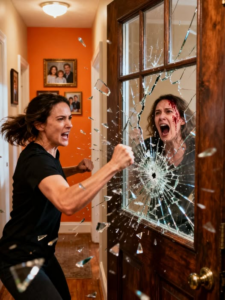
The door slammed with a force that didn’t make sense for something so ordinary.
It wasn’t just a door closing—it was a full, sharp, final crack of sound that sent a vibration through the hallway, followed by a sound I’ll never forget: glass splintering, fracturing, raining down in thin, slicing pieces.
Then—nothing.
The next thing I remember is light. Not warm light. Not morning light. That harsh, sterile hospital light that makes everyone look like they’re made of wax. My eyelids fluttered like they didn’t belong to me. My tongue felt like sandpaper. My head throbbed with a deep, pulsing ache that made the whole world feel underwater.
A monitor beeped steadily beside me. A faint chemical smell clung to the air. I tried to lift my hand, but my arm felt heavy, and something tugged at my skin—an IV line taped down like a leash.
Someone noticed I was awake before I could make a sound.
“Oh, thank God.” My mother’s voice, thick and tired.
I turned my head slowly. It sent a bolt of pain down my neck, and I hissed like a wounded animal.
My mother sat in the chair near the window, clutching a paper cup with both hands. Her eyes were swollen from crying, but the relief that crossed her face didn’t fully soften the tension around her mouth.
“Don’t move,” she said quickly, getting up. “You had a concussion. You’re lucky—so lucky.”
Lucky.
I tried to gather the last memory: the slam, the glass exploding, the way my sister’s face looked—sharp with anger, almost… satisfied.
“Where’s—” My voice scraped out like I hadn’t used it in years.
My mother’s relief flickered.
“Don’t start,” she warned softly, the way you’d warn someone not to touch a bruise.
I swallowed. My throat burned. “Where’s Rowan?”
My mother looked away, just for a second, like her eyes couldn’t bear the direction of that answer.
“She’s home,” she said. “She’s… shaken up.”
I wanted to laugh, but it came out as a pained exhale. “Shaken up? I woke up in a hospital.”
“It was an accident,” my mother said quickly. Too quickly. Like she’d repeated it so many times she’d worn a groove into the air.
My head throbbed harder.
“I remember the door,” I whispered. “I remember her slamming it.”
“She didn’t mean—”
“She never means anything,” I said, and my voice grew steadier as the anger warmed it. “But something always happens anyway.”
My mother pressed her lips together, the same expression she’d worn for years whenever Rowan’s chaos spilled into the rest of our lives. A careful, practiced face. The face of someone choosing the easiest truth.
“You’re stressed,” she said. “You were arguing. You were both upset. The glass—”
“The glass exploded,” I finished. “From a door slam.”
Her jaw tightened. “It was old glass.”
I stared at her. “Is that what she told you?”
Mom’s eyes flashed. “You don’t have to—”
“Yes,” I said, because the question had already answered itself. “That’s what she told you.”
Mom’s shoulders sagged. “Rowan called the ambulance. She stayed with you until they took you.”
I tried to picture it—Rowan calling for help, Rowan acting worried, Rowan performing concern for the right audience. The thought made my stomach twist.
Then a nurse came in, cheerful in that careful way medical professionals are when they know your pain is real but your drama is optional.
“Good morning,” she said. “I’m Tanya. How are we feeling?”
I wanted to answer honestly: Like I’d been hit by a truck driven by someone I used to share a bedroom with.
But I said, “Like my brain is trying to escape my skull.”
Tanya nodded with sympathetic precision. “That tracks.”
She checked my pupils, took my blood pressure, asked me what day it was, who the president was, and what city we were in. I answered everything right. My body might’ve been bruised, but my mind—my mind was already moving.
When she left, my mother resumed her seat like she’d been temporarily dismissed.
“Listen,” she said, lowering her voice. “Just rest. Don’t make this worse.”
I closed my eyes for a second, not because I needed rest, but because if I looked at my mother too long I might say things I couldn’t take back.
“Worse than waking up in a hospital?” I murmured.
Mom exhaled sharply. “Worse than tearing this family apart.”
I opened my eyes again. “This family has been torn for a long time. You just keep folding the ripped edges back together and pretending it holds.”
She flinched like I’d slapped her.
“Why are you like this?” she whispered. “Why can’t you just—let it go?”
Because I’d been letting it go my whole life.
Because every time Rowan crossed a line, my mother moved the line. Because every time Rowan broke something, someone else swept it up. Because every time Rowan lied, my mother called it “complicated.” Because every time Rowan hurt me, my mother called it “sisters.”
I stared at the ceiling until the fluorescent panels blurred.
“I’m going home,” I said finally.
Mom blinked. “You just woke up.”
“I’m going home,” I repeated, and something in my tone must’ve warned her not to argue.
Home smelled like lemon cleaner and tension.
Our mother’s house—technically the house we’d grown up in, though it had never felt like mine—sat at the end of a quiet street lined with manicured lawns and polite neighbors who waved and pretended they didn’t hear screaming through closed windows.
I hadn’t planned to be living there again at twenty-nine. But after my divorce, after my job contract ended, after life decided to wring me out like a washcloth, I’d moved back “temporarily.” That word had stretched into months.
Rowan was still living there too—my younger sister by two years, though she’d always acted like the elder, like the one who owned the air.
The front door looked normal. The hallway looked normal. The place where the glass had exploded had been cleaned so thoroughly it looked like it had never happened.
That, more than anything, made my skin crawl.
Mom hovered behind me as I stepped inside. “Rowan’s in her room,” she said. “She said she’s sorry.”
“Did she?” I asked lightly.
Mom’s eyes darted away again. “Yes. She’s been crying all day.”
I didn’t respond. Crying had never been proof of remorse in our house. Crying was currency. Rowan used it like a master counterfeiter.
My head still ached, but it was the kind of ache that sharpened my focus instead of dulling it. I walked toward the hallway.
Mom caught my elbow. “Please,” she whispered. “Don’t antagonize her.”
I looked down at her hand on me, the gentle grip that somehow always felt like restraint.
“Don’t antagonize her,” I repeated quietly. “Like she’s a bear and I’m responsible for not making her bite.”
Mom’s face hardened. “You know what I mean.”
“I do,” I said. “You’ve meant it my whole life.”
Then I pulled free and walked to Rowan’s room.
The door was shut. Of course it was—Rowan’s door was always a statement. Closed meant “stay out.” Open meant “come worship.”
I knocked once.
No answer.
I knocked again. “Rowan.”
“Go away,” came her voice, muffled and sharp.
I turned the knob. It was locked.
I stared at the lock. It wasn’t new, but it had never been used the way it had lately—Rowan locking herself in like she was the victim hiding from a monster.
Something inside me went still.
“Open the door,” I said.
Silence.
“Open it,” I repeated, and my voice held a quiet promise of consequences.
The lock clicked. The door opened a crack.
Rowan’s face appeared in the gap. Her eyes were red-rimmed, her hair pulled into a messy bun that made her look fragile—an aesthetic she perfected.
“Oh my God,” she whispered, as if seeing me upright was a shock. “You’re—You’re home.”
“Yes,” I said. “And I want to talk about what happened.”
Rowan’s mouth tightened. “I said I’m sorry.”
“You said it through Mom,” I replied. “Try saying it to me.”
Her eyes flickered. “I—Elise, I didn’t mean for the glass to—”
“The glass exploded,” I interrupted. “From you slamming the door.”
Rowan’s nostrils flared. “I didn’t slam it that hard.”
I stared at her. “Rowan, I was there.”
Her voice rose. “You were screaming at me!”
“I was asking you why you took Mom’s credit card again.”
Rowan’s face twisted. “She told you that?”
“She didn’t have to,” I said. “The bank app did.”
Rowan’s eyes flashed with something ugly, then she smoothed it away. “I needed it. She knows I’m struggling.”
“And you thought the best solution was stealing?”
“Borrowing,” she snapped. Then she caught herself, inhaled, forced a tremble into her voice. “Why are you doing this? You’re acting like I tried to hurt you.”
I stepped closer. The room smelled like vanilla body spray and old resentment. Rowan’s bed was perfectly made, as if she’d spent the day arranging her environment instead of feeling anything.
“You did hurt me,” I said.
Rowan’s eyes glistened. “It was an accident.”
I held her gaze. “Was it?”
Her breath caught. “What’s that supposed to mean?”
“It means,” I said, voice calm, “that I woke up in a hospital, and I realized the accident wasn’t the worst thing you’ve done.”
Rowan’s face went blank for a split second—like the mask slipped.
Then she laughed, a brittle sound. “Oh my God. You’re being dramatic.”
There it was. Her favorite weapon. Turn my fear into overreaction, my memory into exaggeration, my pain into inconvenience.
“I remember everything,” I said softly. “Not just the door. The way you looked at me before you slammed it. The way you stood there when the glass shattered. You didn’t even flinch.”
Rowan’s smile tightened. “You’re making things up.”
I nodded slowly, as if I expected that answer. “Okay.”
I turned to leave.
Rowan blinked, confused by my lack of escalation. She wanted a fight. She wanted volume. She wanted proof that I was unstable and she was the calm center.
Instead, I walked down the hallway.
Mom was waiting near the kitchen, face anxious. “How did it go?”
“It went the way it always goes,” I said.
Mom’s eyes filled again. “Please don’t do this.”
“Don’t do what?” I asked. “Notice reality?”
She winced.
I walked past her, into my old bedroom—the one I’d moved back into. My suitcase still sat half-unpacked, as if part of me kept expecting to leave quickly.
I shut my door and leaned against it, breathing through the headache.
Then I heard it: Rowan’s bedroom door closing again, not with a slam this time, but with deliberate, careful pressure. A quiet shut. A message in restraint.
I stared at my ceiling and tried to calm the pounding in my skull.
I told myself: Rest. Heal. Don’t spiral.
But my mind refused to settle. Something about that hallway felt too clean. Too scrubbed. Too curated.
And I couldn’t shake a question that had crawled under my skin like a splinter:
If it was an accident… why did it feel staged?
That night, I couldn’t sleep.
The concussion left me nauseated and alert in alternating waves. Every time I closed my eyes, I heard the glass again. The sound wasn’t just loud—it was intimate, like it had happened inside my bones.
I got up around two in the morning and padded down the hallway, barefoot.
The house was dark except for a faint glow from the kitchen nightlight. The silence was thick, broken only by the refrigerator humming.
I stared at the hallway where the glass had shattered. The wall there was plain, but I remembered—clear as a photograph—that there had been a narrow window panel beside the door. Decorative glass. Old, etched, with a floral pattern.
Now it was gone, replaced with a solid piece of drywall painted to match.
My stomach dropped.
They hadn’t just cleaned up broken glass.
They’d removed evidence.
I ran my fingers along the wall. The paint was fresh, slightly tacky.
My pulse picked up. Mom said the glass was old. If it was old, why replace the entire panel overnight? Why not cover it temporarily, wait for insurance, talk about it?
Unless you wanted it gone fast.
I turned, slowly, looking down the hallway toward the living room.
A small black dome sat in the corner of the ceiling near the front entry—one of those home security cameras Mom had installed last year after a neighbor’s garage got broken into.
I remembered Mom talking about it. “Just for peace of mind,” she’d said, as if we were the kind of family that needed to feel safe from strangers instead of each other.
My throat went dry.
If the camera covered the entryway… it might have caught the door slam.
It might have caught everything.
I walked quietly into the living room, careful not to wake the house, and found the small router cabinet where the security hub was kept. Mom wasn’t tech-savvy. She used the default password for everything and wrote it on sticky notes like a confession.
Sure enough, a sticky note sat inside the cabinet:
Cam Login: Mom1234
I stared at it for a moment, disgust rising like bile.
Then I grabbed my laptop from my room and brought it back to the living room, heart pounding.
I logged into the camera system.
Three cameras. One for the driveway. One for the living room. One for the front hall.
My hands shook as I clicked on “Front Hall.”
A timeline appeared.
I scrolled back to the day of the “accident.”
There was footage. Multiple clips triggered by motion.
I clicked the clip timestamped just minutes before my memory went black.
The video loaded.
There I was on the screen—me in a faded sweatshirt, hair messy, posture tense, holding my phone like a shield. Rowan stood across from me, arms crossed, face pinched with anger.
Even without sound, I could see the rhythm of the argument: my hands moving in measured frustration, Rowan’s body language sharp and dismissive.
Then Rowan stepped toward the door.
I leaned forward, as if trying to stop her from leaving mid-fight.
Rowan turned back.
And there it was—clear as daylight:
Rowan’s mouth formed a smile.
Not a big smile. Not a movie villain grin.
A thin, private curve of satisfaction.
Then she grabbed the door handle with both hands and yanked.
The door slammed.
The glass panel beside it didn’t “explode” naturally. It didn’t shatter outward like old glass breaking from vibration.
It blew inward, as if something had been weakened—scored—prepared.
Tiny shards flew like glittering knives.
I saw myself flinch too late. A piece caught my face. I stumbled back, arms lifting. Then—my body crumpled out of frame.
Rowan didn’t rush to me.
Rowan stood still.
For a full five seconds, she stood there watching my motionless body like she was waiting to see if I’d get back up.
Then she moved—slowly, deliberately—kneeling beside me, touching my shoulder with the careful performance of concern.
The footage ended.
My hands covered my mouth as if I could trap the scream before it escaped.
It wasn’t an accident.
Not with that smile.
Not with that pause.
My chest tightened so sharply I thought I might vomit.
I clicked the next clip.
It started a minute later. Rowan on the phone. Her pacing was frantic—but the kind of frantic you do when you want an audience to believe you’re frantic.
Then Mom entered frame from the kitchen, face panicked.
Rowan turned toward her, gesturing at the glass like it had attacked us. Mom covered her mouth and rushed toward my body.
Rowan grabbed her, pulled her back—like she was preventing Mom from stepping on shards.
Rowan pointed toward the camera.
Mom followed her gaze.
For a moment, Mom stared up at the dome in the corner.
Then—my stomach dropped again—Mom reached for a stool near the entry closet. She dragged it under the camera.
Rowan stepped aside.
Mom climbed up and angled the camera away from the hall.
Not off. Just away.
So it wouldn’t catch what happened next.
The clip ended.
My blood turned cold.
My mother… helped.
Maybe not in the beginning. Maybe she didn’t plan it. But the moment she realized what the camera saw, she chose Rowan.
She chose the story.
I sat frozen on the living room floor, laptop glowing like a wound.
The “accident” hadn’t been the worst thing Rowan had done.
The worst thing was that she could do this and still be protected.
Still be chosen.
Still be enabled until she became someone who didn’t just break things—she broke people.
I closed the laptop slowly, like I might wake the house if I moved too fast.
Then I went back to my room and locked my door.
I lay in bed staring at the ceiling until dawn, the footage replaying behind my eyes.
I didn’t cry.
I planned.
Rowan always underestimated me.
In her mind, I was the responsible sister. The boring sister. The one who tried to keep peace. The one who would fold and swallow and clean up.
She thought I’d rage, accuse, and get dismissed as “emotional.”
So I didn’t do that.
I waited.
I went through the next day like I was walking on thin ice over deep water. I smiled at Mom when she offered soup. I told Rowan I still felt dizzy but I was fine.
Rowan watched me over her coffee mug like she was measuring whether I remembered.
“You seem… calmer,” she said casually.
I met her eyes. “Maybe the concussion knocked the drama out of me.”
Rowan’s lips twitched. “Good.”
Mom’s shoulders relaxed like she’d been holding her breath.
That night, when everyone was asleep, I went back to the camera system.
I downloaded the clips.
I copied them onto a flash drive.
Then I did one more thing: I emailed the clips to myself from a new account I created—an account Mom didn’t know existed—so the evidence would live somewhere outside the house.
Because the moment Rowan sensed danger, she’d burn everything down.
Rowan wasn’t just impulsive.
Rowan was strategic when cornered.
I knew that because I’d lived it.
When we were kids, Rowan used to “accidentally” spill juice on my homework right before it was due. She’d “accidentally” tell my crush I liked him, then pretend she was being helpful. When I got a scholarship interview in high school, Rowan had told Mom I was “lying about the date,” and I almost missed it—until I called the school myself.
Rowan didn’t just want attention.
Rowan wanted control.
And she wanted me small.
I couldn’t change the past. But I could stop the future.
The problem was: if I went to the police with footage of glass shattering and me collapsing, they’d ask questions. They’d want medical records. They’d want motive. And motive is where my family would twist the knife.
Rowan would cry and say I was jealous. Mom would say I was stressed and confused.
So I needed more than footage.
I needed truth that couldn’t be smoothed over.
I needed to understand what Rowan was really doing—what she was protecting.
Because people don’t escalate to violence for no reason.
They escalate when something is at stake.
The answer came three days later, when I overheard Rowan on the phone.
I was in the laundry room, folding towels with slow, careful movements because my head still swam if I moved too fast. Rowan’s voice floated from the kitchen, low and urgent.
“I told you I’m handling it,” she hissed. “No, she didn’t see—she can’t prove—”
I froze, towel in my hands.
Rowan continued, pacing.
“…because Mom will sign. She always signs. I just need time. And I need Elise out of the way.”
My stomach clenched.
She was talking about me like I was an obstacle on a to-do list.
I stepped closer to the doorway, staying in shadow.
Rowan’s voice sharpened. “No, I’m not saying I hurt her. I’m saying she’s inconvenient. She’s snooping. She’ll ruin this if she—”
A pause.
Rowan’s tone shifted, coaxing now. “I know you want the money. I want it too. Just let me do this my way.”
Money.
My pulse thudded.
Rowan laughed softly. “Please. Mom’s house is worth a fortune. And she’s not going to live forever. But if we get her to sign now? It’s clean. It’s quick.”
My throat went dry.
She was talking about Mom’s house.
About getting her to sign something.
I leaned closer and caught the last part of Rowan’s sentence:
“…the power of attorney. Then we can refinance, pull equity, whatever we need. She won’t even understand what happened.”
I stumbled back silently, bile rising.
Power of attorney.
Rowan wasn’t just stealing Mom’s credit card.
Rowan was trying to legally take control of Mom.
To drain her.
And I was “in the way.”
My mind connected pieces like puzzle tiles snapping into place.
The sudden “accident” that landed me in the hospital.
The rushed replacement of the glass panel.
Mom redirecting the camera.
Rowan’s calm satisfaction.
It wasn’t just anger.
It was insurance.
If I was injured, if I was unstable, if I left the house—or got pushed out—Rowan could corner Mom without my interference.
And Mom, terrified of conflict, would sign anything Rowan put in front of her if Rowan cried hard enough.
I didn’t sleep that night.
I sat at my desk with the flash drive in my palm and the weight of a truth that finally had shape:
Rowan wasn’t spiraling.
Rowan was executing.
And my mother—my mother was either complicit, or a frightened accomplice, or a woman being slowly trained to betray her own child to keep the peace.
Either way, it ended now.
The next morning, I called my aunt Denise—Mom’s older sister, the only adult in my childhood who ever looked Rowan in the eye and said, “No.”
Aunt Denise answered on the second ring. “Elise? Honey? What’s wrong?”
My voice shook, but I made it steady. “I need you to come over. Today. And I need you to bring Uncle Mark if he’s home.”
A pause. “Is it Rowan?”
“Yes,” I said. “And Mom. And I’m not… I’m not safe here.”
Aunt Denise’s tone hardened. “I’m on my way.”
Then I called my friend Kira—the one who never accepted “family” as an excuse for abuse.
“Kira,” I said when she picked up, “I need you to meet me later. And I might need a place to stay.”
Kira didn’t ask why. “Name the time.”
Then I did something that felt like stepping off a cliff: I called an attorney.
Not Marisol from my old job—this wasn’t a workplace favor. This was my life.
I found a local family law attorney who specialized in elder abuse and protective orders. Her assistant listened calmly while I summarized—hospital, footage, power of attorney talk.
“We can see you this afternoon,” she said.
I hung up and stared at my hands.
I wasn’t just going to confront Rowan.
I was going to outmaneuver her.
Rowan’s strength was chaos. Mine was preparation.
The opportunity came sooner than I expected.
That afternoon, Rowan breezed into the kitchen with a manila folder and a too-bright smile. Mom sat at the table with a cup of tea, shoulders hunched like she was bracing for weather.
“Mom,” Rowan chirped, “I found a way to help with your bills. Just some paperwork. Nothing scary.”
Mom’s eyes flicked to the folder like it might bite her.
I walked into the kitchen quietly and leaned against the counter.
Rowan’s smile faltered when she saw me.
“Oh,” she said. “You’re up.”
“I live here,” I replied pleasantly.
Rowan’s gaze narrowed. “This doesn’t involve you.”
“It’s paperwork,” I said. “You love paperwork. What is it?”
Rowan put a hand over the folder like a magician guarding a trick. “It’s just something to help Mom—”
“With what?” I asked.
Rowan’s jaw tightened. “Why do you always assume the worst?”
“Because I’ve met you,” I said calmly.
Mom’s voice trembled. “Elise, please—”
“Mom,” I said softly, stepping closer, “what did she tell you this is?”
Mom swallowed. “She said… it’s something so she can help pay things. Since she’s been… struggling.”
Rowan shot me a warning look. “Don’t make this a thing.”
I smiled. “Okay. Let’s not make it a thing. Let’s just read it.”
Rowan’s face hardened. “No.”
I tilted my head. “Why not?”
“Because you’ll twist it,” Rowan snapped, then immediately softened. “Mom, don’t listen to her. Elise is still confused from her head injury. The doctor said—”
My blood turned to ice. There it was. Her backup plan: make me seem unreliable.
I walked to the table and sat down across from Mom. “Mom,” I said gently, “I want you to do something for me. Before you sign anything—anything at all—you hand it to me and we read it together. If it’s harmless, great. If it’s not, we stop.”
Rowan’s voice rose. “This is ridiculous.”
Mom’s hands shook around her tea cup. “Rowan, maybe—”
Rowan slammed the folder onto the table.
The sound made Mom flinch.
Rowan leaned forward, eyes bright and furious. “You always do this,” she hissed at me. “You always insert yourself. You always act like you’re the hero.”
I kept my voice level. “I’m not a hero. I’m a person who doesn’t want Mom tricked into signing away her rights.”
Rowan laughed, sharp. “Rights? She’s my mother too.”
“You’re treating her like a bank account,” I said.
Rowan’s face flushed. “You don’t know anything.”
“I know you stole her credit card,” I said. “I know you’ve been calling someone about a power of attorney.”
Rowan froze.
Mom’s eyes widened. “Rowan…?”
Rowan’s gaze snapped to Mom, panic flickering—then she rearranged her face into tears. Fast. Smooth. Like turning on a faucet.
“Mom,” she cried, “she’s lying! She hates me—she’s always hated me! She’s trying to turn you against me because she’s miserable!”
Mom’s expression collapsed into confusion and guilt, like always.
Rowan reached for Mom’s hand. “Please, Mom. You know me. You know I’d never—”
I stood up.
“Stop,” I said, not loud, but solid.
Rowan blinked at me through fake tears. “What?”
“I said stop,” I repeated. “Don’t touch her like that. Don’t cry at her like it’s a weapon.”
Rowan’s tears vanished so quickly it was almost funny.
She stared at me, eyes cold. “You’re playing a dangerous game.”
I smiled faintly. “You have no idea.”
At that moment, the front door opened.
Aunt Denise walked in like a storm given human form. Uncle Mark followed, broad-shouldered and quiet, carrying a small tool bag like he’d come to fix something—maybe he had.
Denise took one look at Rowan, then at Mom’s face, then at the folder on the table.
“What’s going on?” Denise demanded.
Rowan’s mouth opened, but no sound came out.
Mom stammered, “Denise, I—”
Denise put a hand on Mom’s shoulder. “Don’t. Just sit.”
Rowan’s eyes flashed. “Who invited you?”
“I did,” I said. “Because we need witnesses.”
Rowan’s laugh was breathless. “Witnesses to what? Elise’s paranoia?”
I pulled the flash drive from my pocket and placed it on the table.
“Witnesses to this,” I said.
Rowan’s face went pale.
Mom stared at the flash drive like it was a grenade.
Denise’s expression sharpened. “Elise?”
I met her eyes. “There’s camera footage from the day the glass shattered.”
Rowan lunged forward. “You can’t—”
Uncle Mark stepped between us so smoothly it was almost elegant. He didn’t touch Rowan, just blocked her path with the simple fact of his body.
Rowan’s nostrils flared. “Move.”
Denise pointed at the folder. “What is that?”
Rowan tried to smile again. “It’s nothing. It’s just—”
Denise snatched the folder and opened it, scanning the pages with a speed that made my chest tighten.
Her face darkened.
“This is a durable power of attorney,” Denise said flatly, looking at Mom. “Rowan would control your finances, your medical decisions—everything.”
Mom’s face drained of color. “Rowan…?”
Rowan’s voice turned syrupy. “Mom, it’s just so I can help—”
Denise slammed the folder shut. “Help yourself.”
Rowan’s mask cracked. “You don’t understand.”
“Oh, I understand,” Denise snapped. “I understand you’ve been bleeding your mother dry since you were sixteen. I understand you’re trying to steal her autonomy because you’re too lazy to build your own life.”
Rowan’s eyes went wild. “Shut up!”
Mom began to cry. “Rowan, why would you—”
Rowan rounded on Mom, fury spilling. “Because you won’t do anything! Because you just sit there and let Elise judge me like she’s perfect!”
Denise’s voice cut through like a knife. “Rowan. Sit down.”
Rowan laughed. “Or what? You’ll call the cops? On family?”
Denise’s eyes flicked to me. “Elise?”
I nodded. “I have the footage. And I have an appointment with an attorney.”
Rowan’s breath hitched.
Mom’s tears slowed, replaced by a trembling fear. “Footage of what?”
I swallowed. My voice shook despite my effort. “Footage of Rowan slamming the door. And you… moving the camera after.”
Mom’s face crumpled. “I didn’t—”
“You did,” I said softly. “I saw it.”
Mom’s mouth opened and closed like she couldn’t breathe.
Rowan backed toward the hallway, eyes darting like a trapped animal.
“This is insane,” she whispered. “You’re all insane.”
Denise stepped forward. “No. You’re exposed.”
Rowan’s gaze landed on me, pure hatred now, no performance left.
“You think you’re so smart,” she hissed. “You think you can ruin me.”
I held her stare. “You ruined you.”
Rowan’s voice dropped low. “You shouldn’t have looked.”
A chill crawled down my spine.
Denise didn’t miss it. “Rowan,” she said sharply, “you’re leaving. Now.”
Rowan’s laugh was broken. “This is my house too.”
Denise’s eyes flashed. “Not anymore.”
Rowan’s jaw clenched. “You can’t kick me out.”
“I can,” Mom said suddenly.
We all froze.
Mom’s voice was small, shaking, but it came again—stronger.
“I can,” she repeated. “Because… because I’m tired.”
Rowan stared at Mom like she’d been betrayed.
“You’re choosing her?” Rowan spat.
Mom’s tears slid down her cheeks. “I’m choosing… reality.”
Rowan’s face twisted, and for a moment I saw the child she’d once been—wild, hungry for control, terrified of abandonment.
Then it hardened into something colder.
“Fine,” Rowan said softly. “You want me gone? I’ll go.”
She turned toward the hallway.
Denise barked, “Not alone. Mark, go with her.”
Uncle Mark followed Rowan down the hall to ensure she packed and left without stealing anything.
Rowan’s footsteps were heavy, angry.
Mom sat trembling, hands clasped tightly. Denise wrapped an arm around her shoulders.
I stood there with the flash drive on the table, feeling like I’d just pulled a rotten beam out of a collapsing house.
The quiet that followed was not peaceful.
It was the silence after a storm, when you look around and see what’s been destroyed.
Rowan left that night.
Not gracefully. Not remorsefully. She grabbed a duffel bag, a makeup case, and the folder Denise had confiscated—which Denise did not allow her to take. Rowan tried to snatch it. Uncle Mark stopped her with one stern look.
Rowan’s parting words were for me.
As she stood in the doorway, hair messy, eyes burning, she said, “You’re going to regret this.”
I met her gaze. “No,” I said. “You are.”
She walked out into the night and slammed the door again—this time gently, controlled, like she knew the sound carried consequences now.
Mom collapsed into sobs the moment Rowan was gone.
Denise guided her to the couch like she was escorting someone out of a burning building. “It’s okay,” Denise murmured, but her voice held anger too. “It’s going to be okay.”
Mom shook her head. “I did this,” she whispered. “I made her like this.”
Denise’s jaw tightened. “You enabled her. That’s different.”
Mom looked at me, eyes red and raw. “Elise… I didn’t want you to hate me.”
I felt something twist inside my chest. “Mom,” I said quietly, “I didn’t want to wake up in a hospital and realize you’d rather protect Rowan than protect me.”
Mom’s lips trembled. “I panicked. When I saw the camera, I thought—if someone sees, Rowan will—she’ll be ruined.”
“And what about me?” I asked, voice breaking despite myself. “What about Owen—if I had a child? What about your own safety? She was trying to take control of your life.”
Mom covered her face. “I know.”
Denise squeezed her shoulder. “Then we fix it. We do it the right way. Elise, what’s your plan?”
I inhaled slowly. “We go to the attorney tomorrow. We file a protective order if we can. We document the attempted power of attorney manipulation. We lock down Mom’s finances. And… we give the footage to the police.”
Mom flinched. “Police?”
“Yes,” I said, and my voice steadied. “Because if Rowan did this once, she’ll do it again. Maybe not to me. Maybe to someone else. But she’ll escalate.”
Denise nodded sharply. “Good.”
Mom’s voice was tiny. “She’s my daughter.”
Denise looked at her. “So is Elise.”
Mom cried harder.
I didn’t comfort her immediately. Not because I was cruel, but because I’d spent years comforting everyone else while my own pain got minimized. My body still ached. My head still throbbed. And I needed Mom to sit in the consequence of her choices.
The next day, we met with the attorney—Ms. Harmon.
She watched the footage without blinking. When Rowan’s small smile appeared on screen, Ms. Harmon’s expression didn’t change, but the air around her seemed to sharpen.
When it was over, she said calmly, “This is significant.”
Mom’s hands shook. “Is it… a crime?”
“It may be,” Ms. Harmon said. “At minimum, it’s evidence of reckless endangerment and potentially aggravated assault depending on intent and injury. It also supports a protective order, especially given the financial exploitation attempt.”
Denise leaned forward. “What do we do?”
Ms. Harmon laid out steps like she’d done it a thousand times:
- Immediate financial protections: freeze credit, move accounts, revoke access, notify banks.
- A formal revocation letter to preempt any power of attorney fraud attempt.
- File for a protective order based on the injury and the threats.
- Report to Adult Protective Services regarding suspected financial exploitation.
- Consider a police report with medical documentation and video evidence.
Mom looked like she might faint.
I felt strangely calm.
Because for the first time, there was a plan that didn’t require begging Rowan to act human.
It required accountability.
We spent the next week locking everything down.
Mom cried a lot. She grieved not just Rowan, but the fantasy of Rowan—who she wanted her to be, not who she was.
Denise stayed over like a guard dog. Uncle Mark installed new locks. Mom finally changed passwords. We pulled credit reports and found two credit cards I’d never heard of opened in Mom’s name.
Rowan’s “borrowing” hadn’t been borrowing.
It had been theft.
When the police came to take my statement, I expected to feel embarrassed, like I was airing dirty laundry. But the officer—Officer Ruiz—watched the footage and his face hardened.
“This isn’t normal sibling conflict,” he said. “This is dangerous behavior.”
I nodded. “I know.”
Ruiz asked, “Did she ever threaten you before?”
I thought of Rowan’s words—You shouldn’t have looked.
“Yes,” I said. “And she used my mother to cover it.”
Mom sobbed quietly in the next room.
Ruiz’s gaze softened slightly. “We’ll take it seriously.”
They filed it. They opened an investigation. They referred Mom’s situation to Adult Protective Services.
Rowan, meanwhile, began her retaliation campaign.
She texted me long paragraphs about betrayal and family and forgiveness. She left voicemails crying. Then screaming. She messaged Mom photos of us as kids with captions like Remember when you loved me?
When that didn’t work, Rowan switched tactics: she showed up.
The first time, she stood in the driveway at dusk, arms wrapped around herself like she was cold.
Mom peeked through the curtains, trembling.
“She looks… sad,” Mom whispered.
Denise stepped beside her. “Sad doesn’t mean safe.”
Rowan called out, voice carrying. “Mom! Please! I just want to talk!”
Mom’s hand lifted as if she might reach for the door handle.
I stepped in front of her. “If you open that door,” I said gently, “you’re opening the cage again.”
Mom’s eyes filled. “What if she—”
“She already did,” I said. “She already hurt me. She already tried to trap you. She doesn’t get rewarded with access.”
Denise called the police.
Rowan saw the patrol car turn the corner and fled like a ghost.
The second time she came, she didn’t run.
She screamed. Loud enough for neighbors to peek out.
“She’s lying!” Rowan shouted. “She fell! Elise fell and now she’s framing me!”
The humiliation burned, but I stood in the living room behind the locked door, staring at Rowan through the glass like she was a stranger.
Officer Ruiz arrived again and spoke to her. Rowan cried on command. She clutched her chest. She told him she missed her mother.
Ruiz didn’t budge.
He issued a trespass warning.
Rowan glared at the house before leaving, and even through the window I could feel her rage like heat.
That night, I couldn’t sleep again.
Not because I doubted my choices—because I didn’t.
But because I finally understood something about Rowan that scared me:
Rowan didn’t think consequences were real.
Rowan thought consequences were for other people.
So when they finally reached her, she would not accept them quietly.
She would try one last big move to regain control.
And I needed to be ready.
Rowan’s final move came as a letter.
Not a text. Not a call. Something more official.
A man in a suit came to the door and handed me an envelope.
“You’ve been served,” he said.
My stomach sank.
Inside was a petition—Rowan attempting to claim Mom was mentally unfit and needed a guardian.
Rowan wanted to take Mom’s autonomy by force.
She was accusing us—me and Denise—of manipulating Mom.
It was almost impressive in its audacity.
Denise read it and swore under her breath. “Oh, she’s going to war.”
Mom looked like she’d been punched. “I’m not unfit.”
“I know,” I said, taking her hand.
Mom’s voice shook. “How could she do this?”
Denise’s eyes were hard. “Because she’s desperate now. And desperate people get ugly.”
Ms. Harmon responded within two days, filing a counter-motion, attaching evidence of Rowan’s financial exploitation, the video footage, the credit card fraud, and the police reports. She requested a hearing and asked for the petition to be dismissed as malicious.
The hearing was scheduled quickly.
The morning of court, I wore a simple blazer and kept my hair pulled back. My concussion symptoms had mostly faded, but the emotional bruises were fresh.
Rowan arrived with a lawyer I’d never seen and a face full of practiced sorrow.
When she saw me, she smiled faintly, like she believed she was still playing a game she could win.
In the courtroom, Rowan testified first.
She painted herself as a concerned daughter. She said Mom was confused, vulnerable, manipulated by “jealous” relatives. She cried when she described me as “violent” and “unstable.”
My nails dug into my palm as she spoke.
Then Ms. Harmon stood.
“Your Honor,” she said, “we have evidence that directly contradicts the petitioner’s narrative.”
She played the footage.
The courtroom went so silent I could hear the soft hum of the projector.
Rowan’s face changed as the clip played. At first she stayed still, confident. Then—when her small smile appeared—her eyes widened. When she stood over my collapsed body, her posture stiffened. When Mom moved the camera away, Mom began to sob quietly beside Denise.
Rowan’s lawyer whispered to her.
Rowan stared straight ahead, jaw clenched like she might crack a tooth.
When the footage ended, Ms. Harmon calmly introduced the financial records: the fraudulent credit cards, the attempted power of attorney, the credit card theft, the bank transfers.
Then she called Officer Ruiz, who confirmed the reports and the trespass warning.
Rowan’s story shrank in the light of evidence until it looked like what it was: a performance with rotten wiring underneath.
The judge’s expression did not soften for tears.
He dismissed Rowan’s petition.
Then he did something better: he warned her.
He issued a no-contact order pending the outcome of the ongoing investigation. He referred the fraud evidence for review. He looked at Rowan with the tired sternness of someone who’d seen this pattern before.
“Ms. Hale,” he said, “your actions suggest a pattern of manipulation and exploitation. This court will not be used as a tool for harassment.”
Rowan’s face went pale.
For the first time in my life, Rowan looked… small.
Not because she felt remorse.
Because she realized the world wasn’t bending for her anymore.
As we left the courtroom, Rowan’s gaze locked onto mine.
Her lips moved without sound, but I read them anyway:
This isn’t over.
I stopped walking.
Denise tugged my sleeve. “Elise—”
I turned to Rowan, my heart steady in a way it had never been around her.
“It is,” I said clearly.
Rowan’s eyes flashed.
I didn’t wait for a reply.
I walked out.
The aftermath wasn’t tidy.
Rowan didn’t magically become good. She didn’t apologize in a way that mattered. She didn’t transform into a sister who could be trusted.
She disappeared for a while. Changed numbers. Surfaced occasionally through mutual acquaintances, spinning new versions of the story where she was the victim.
But the legal machine moved slower than her lies.
The fraud investigation uncovered more than we expected: Rowan had used Mom’s information to open accounts over the last two years. She’d taken out small loans. She’d forged Mom’s signature on one document.
The prosecutors offered Rowan a plea deal: return funds, accept probation, enroll in mandated counseling, and stay away.
Rowan took it.
Not because she felt sorry.
Because for once, there was no audience she could charm into erasing her consequences.
Mom grieved in waves.
Some days she was furious, calling Rowan what she’d avoided saying for years: manipulative, cruel, dangerous.
Other days she was hollow, staring at old photos like she could reverse time.
I didn’t rescue her from that grief.
I sat beside her through it.
Because grief was honest. It meant Mom was finally seeing reality.
One night, months later, Mom sat at the kitchen table with a cup of tea—real tea this time, not the trembling kind.
“I need to tell you something,” she said.
I looked up.
Mom’s eyes were clear. “When I moved that camera… I told myself I was protecting Rowan.”
My stomach tightened.
Mom continued, voice low. “But I realize now… I was also protecting myself. From the shame of admitting what she’d become. From the guilt. From the fact that I let it get this far.”
Tears filled her eyes, but she didn’t crumble.
“I’m sorry,” she said. “I’m sorry I failed you.”
Something in me unclenched.
I didn’t forgive her instantly like a movie scene. Forgiveness wasn’t a switch. It was a process. But I nodded.
“I needed you to say that,” I admitted.
Mom reached across the table, palm up, not grabbing—offering.
I placed my hand in hers.
We sat like that for a long time, quiet and human.
The house felt different now. Not because it was perfect, but because it wasn’t lying anymore.
I moved out a few months later into a small apartment with sunlight and no history baked into the walls. Kira helped me unpack. We laughed about how I kept every mug I’d ever owned.
On my first night there, I realized I could breathe fully.
No slamming doors.
No walking on eggshells.
No fear that love would be used as leverage.
Rowan didn’t contact me again after the no-contact order became permanent.
Sometimes, late at night, I would remember the sound of the glass and feel my body tense.
But then I’d remember something else too: the footage, the proof, the moment the truth stopped being a whisper and became a weapon in my hands.
Rowan had always counted on one thing.
That no one would believe me.
That I would doubt myself.
That I would be too polite to name what she was.
She was wrong.
And that was the real consequence.
Not the court order.
Not the plea deal.
Not the money.
The real consequence was that I woke up in a hospital and finally stopped pretending the worst thing Rowan did was an “accident.”
The worst thing she did was teach our whole family to live in a reality where her harm was normal.
And once you see that clearly, you can’t unsee it.
You can only end it.
Để lại một phản hồi