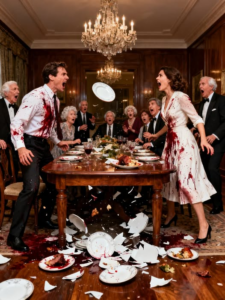
The dining room in Naperville, Illinois smelled like rosemary chicken and expensive wine—Camila Petrova’s apartment always did when she hosted, because she treated every family gathering like a performance.
Her place sat on the top floor of a new building with a lobby that looked like a boutique hotel and a doorman who greeted Camila as if she were royalty. The walls inside were white and glossy. The art was “abstract” in a way that meant it cost too much. Even the candles were staged—three matching glass jars, perfectly spaced, flickering like a curated mood.
I’d learned to hate how calm everything looked in Camila’s home.
Because calm, in that family, was never peace.
It was a trap.
Camila—my boyfriend Andre’s mother—glided around the kitchen island in a cream sweater and pearl earrings, smiling like she was about to present an award show rather than serve dinner. Andre’s sister Daria had arrived in a blazer and heels like she’d come straight from court. Andre’s younger brother Mark lounged on the sofa, half watching the game, half watching me.
And Andre? He leaned against the counter with a glass of wine in his hand, looking handsome in that effortless way that made strangers assume he was kind. He’d always been good at looking like a good man.
I adjusted my blouse at the collar, as if a tighter button could stop my pulse from climbing. My name is Nina, and I’d told myself I was here to “make an effort,” to show Andre’s family I wasn’t just the girlfriend who worked late at the clinic and didn’t call enough.
But deep down, I knew why I came.
I came because Andre wanted an audience.
Camila placed the platter on the dining table like she was unveiling a painting. “Dinner is ready. Nina, dear, sit next to Andre.”
The “dear” made my skin prickle. It sounded warm and looked warm—but it was measured, a word chosen for optics. Camila’s kindness was always for the room. Never for the person.
We sat. Mark took the end seat. Daria perched like a judge. Camila took the head of the table, her kingdom, her spotlight.
Glasses clinked. Napkins unfolded.
Andre’s knee pressed into mine under the table—an affectionate gesture if you didn’t know him. If you didn’t know that the pressure of his knee could also be a warning.
Smile, that knee said. Don’t embarrass me.
Camila raised her glass. “To family.”
“To family,” everyone echoed.
I said it too, because I’d learned you can drown faster if you struggle.
We ate. Camila asked about my work at the pediatric clinic, but she didn’t ask because she cared. She asked the way people ask about a brand they might invest in: What are the numbers? What’s the prestige? What can you offer?
I gave polite answers. I talked about kids and vaccines and the sweet way a toddler’s hand feels when they trust you. Andre nodded occasionally, mostly watching the room like a performer waiting for his cue.
Then Camila set down her fork, dabbed her mouth with a napkin, and said, “Andre tells me you’ve been… hesitant about helping more.”
I blinked. “Helping more with what?”
The air changed—still scented with rosemary, but heavier now, like the smell had thickened into something you could choke on.
Andre smiled without his eyes. “My mom’s been clear, Nina. She needs support. It’s not complicated.”
Camila’s expression softened into practiced sadness. “I’ve done so much for my children. I don’t ask for much. Just… stability.”
Daria leaned in slightly, eyes sharp. “Mother’s retirement situation isn’t ideal. And with property taxes and building fees—”
Andre cut her off with a raised hand, as if he wanted the moment to be intimate, not logistical. “Nina knows. We’ve discussed it. I’m just tired of repeating myself.”
My stomach dropped. I could feel my heartbeat in my throat. “Andre, we talked about helping sometimes. We didn’t talk about—”
He set his glass down with a clean, deliberate click. “Twelve hundred a month. That’s what she needs.”
I stared at him. “Twelve hundred?”
“Not even that much,” Mark muttered, smirking.
“It’s… it’s more than my car payment,” I said, voice small despite my effort to keep it steady. “Andre, I have student loans. I pay my share of rent. I—”
Andre tilted his head like he was studying a stubborn child. “And yet you always have money for your little ‘self-care’ stuff. Your serums. Your overpriced coffee. Your—what do you call it—therapy?”
My face burned. Therapy had been the one thing I’d done quietly, privately, because Andre hated anything that made me “less manageable.” He called it “excuses disguised as healing.”
Camila gave a sympathetic sigh that was entirely for show. “Nina, dear, a woman who loves her partner supports his family. It’s traditional.”
“It’s not tradition,” I said. “It’s… it’s a demand.”
Andre’s knee pressed harder into mine. He smiled wider. “Don’t get dramatic.”
The word “dramatic” in Andre’s mouth always meant: Shut up.
I looked around the table. Daria watched like she was waiting for me to crack. Mark looked entertained. Camila looked saintly.
And Andre looked like a man who had already decided I was wrong.
“No,” I said, surprising myself. “I’m not agreeing to that. Not like this.”
The smile on Andre’s face twitched. “What do you mean, not like this?”
“I mean,” I said carefully, “if you want to help your mom, that’s your choice. But you can’t just announce a monthly fee for me like I’m… like I’m a resource you can tap.”
Camila’s eyes narrowed for a split second—so quick it could’ve been imagined. Then she smoothed her expression again. “Andre just wants to know you’re serious.”
“I am serious,” I said. “But I’m not paying twelve hundred dollars a month to prove it.”
Andre’s fork paused midair. His voice went colder. “So what, you’re useless to us?”
The word landed like a slap, and my ears rang with it.
I felt something in me tremble—not fear exactly, but the old instinct to shrink, to apologize, to fix it. That instinct was a habit I’d been trained into, by Andre in small doses over two years.
The first time he called me useless, it had been in my own apartment, after I forgot to pick up his dry cleaning. He’d said it like a joke.
The tenth time, it wasn’t a joke.
At the table, Camila made a small noise of disappointment, as if I’d embarrassed her with bad manners instead of Andre embarrassing me with cruelty.
Daria sipped her wine. Mark’s smirk widened.
I forced my hands to unclench. “Don’t call me that.”
Andre laughed—one short, sharp burst. “Why? It’s accurate.”
My vision sharpened at the edges, like the world was coming into focus for the first time. In my head, a quiet voice said: This is what they really think of you. Not a girlfriend. Not a partner. A paycheck.
I set my fork down. “Andre. If you talk to me like that again, I’m leaving.”
The room went still.
Camila’s lips parted like she was about to scold me for threatening the harmony. Daria’s eyebrows rose. Mark leaned forward.
Andre stared at me. Then his face shifted into that expression he used when he wanted to punish me without looking like the villain.
He stood.
The chair legs scraped the floor with a sound that made my skin crawl.
“I’m sorry,” he said loudly, addressing the room, “but Nina’s been… emotional lately. She’s under stress. She’s been making things difficult.”
He put a hand on my shoulder, squeezing just hard enough to hurt. “Right, babe?”
My body tensed. I looked up at him. His fingers were firm, possessive. That touch wasn’t affection. It was control.
In the silence, the candle flames fluttered.
I stood too.
Andre’s grip tightened, his thumb digging into a tender spot near my collarbone. “Sit down,” he said through a smile.
I heard it clearly, even if the others didn’t. The words were barely breathed. A private order.
I didn’t sit.
Andre’s eyes hardened.
“Don’t,” I warned quietly. “Not here.”
He leaned closer, his breath wine-sweet. “You don’t get to threaten me in front of my family.”
Camila’s voice turned syrupy. “Andre, darling, let her breathe. Nina, sweet girl, we can talk calmly—”
But Andre’s hand slid from my shoulder down my arm, locking around my wrist.
My pulse spiked. “Let go.”
His smile stayed in place like a mask. “You’re not leaving until this is resolved.”
It happened fast, the way violence often does when it’s been waiting behind someone’s teeth for a while.
I pulled my wrist back.
Andre yanked harder.
The edge of the table caught my hip. My wineglass tipped, splashing red across the white tablecloth like a fresh stain nobody could ignore.
“Andre,” I said, louder now, “stop.”
“Stop?” he repeated, mockingly. “Stop what?”
Then he shoved my hand down onto the table—hard.
Something sharp bit into my palm.
Pain shot up my arm like electricity.
I looked down. My wineglass had shattered when it fell, and a jagged triangle of glass had sliced the base of my thumb. Blood welled immediately, bright against the white cloth, dripping in slow, thick drops like a warning.
For a second, everyone froze.
Even Andre.
Then Camila gasped dramatically. “Oh my God! Nina!”
Daria’s chair scraped back. Mark swore under his breath.
Andre stared at the blood, and the mask on his face faltered. But only for a second—then it snapped back into place.
He stepped away, lifting his hands. “She did that herself. She yanked the glass. I didn’t—”
I stared at him, breathing hard.
My hand throbbed. Blood ran down my wrist.
But the pain did something strange.
It cleared my head.
It made everything simple.
Andre didn’t panic because I was hurt. He panicked because the room had seen something real.
Camila rushed to the kitchen for paper towels, calling out, “We need ice! We need—”
Andre’s voice rose over hers. “Nina, why would you do that? Why are you acting like this?”
He turned to his family, wide-eyed, performing innocence. “She’s been unstable. I’ve been trying to help her.”
Daria’s face tightened. “Nina… are you okay? That’s a lot of blood.”
Mark looked at Andre, then at me, uncertainty flickering through his smugness.
And that’s when I realized something that made my mouth go dry:
They weren’t sure.
They didn’t know Andre the way I did.
They knew his version.
His polished, edited, charming version.
But blood—blood is hard to edit.
Camila returned, pressing towels into my hand. “Hold it tight, dear. Tight.”
I did, because the cut was real and I needed pressure. But my eyes stayed on Andre.
He stepped closer again, lowering his voice. “Don’t make this bigger than it is,” he hissed. “You’re embarrassing me.”
The word “embarrassing” hit the same place fear used to live.
But fear wasn’t what I felt.
I felt clarity.
I looked at him, bleeding, and I smiled.
Not because I was happy.
Because I finally understood what to do.
“Okay,” I said softly.
Andre’s shoulders loosened a fraction, thinking he’d won.
Then I lifted my phone with my uninjured hand.
Andre’s eyes narrowed. “What are you doing?”
I unlocked it. My thumb hovered over the screen, and I watched his face change as he realized I wasn’t texting an apology.
“I’m calling 911,” I said.
Camila froze. “Nina, dear—maybe that’s unnecessary—”
Andre lunged for my phone.
In that moment, something in me snapped into place—something steady and sharp.
I stepped back. “Don’t touch me,” I said, loud enough for everyone to hear.
Andre’s hand hovered in the air, caught between grabbing and pretending he wouldn’t. His face twisted with rage, then smoothed again.
He tried the gentle voice. “Babe, come on. We can handle this privately.”
I kept smiling.
Because now he was trapped.
If he grabbed me, they’d see it.
If he didn’t, I’d call anyway.
I hit the call button.
Andre’s jaw clenched. Camila’s eyes darted around the room like she was searching for an exit in her own home.
The dispatcher answered. I spoke clearly, even with my pulse pounding.
“I’m at an apartment in Naperville,” I said, “and I’ve been injured during an altercation. My boyfriend grabbed my wrist and shoved my hand down onto a table with broken glass. I’m bleeding.”
Camila made a distressed sound. Daria looked pale. Mark’s mouth hung open slightly.
Andre stared at me like I’d become someone else.
Because I had.
The dispatcher asked if the attacker was still there.
“Yes,” I said, looking directly at Andre. “He’s right in front of me.”
Andre’s voice rose, aimed at the room. “This is insane. Nina, you’re lying!”
The dispatcher heard him. “Ma’am, are you safe right now?”
“No,” I said. “But I’m staying by the door.”
Andre took a step toward me. Mark stood abruptly, holding a hand out to Andre as if to stop him.
“Andre,” Mark said, voice tight, “don’t.”
Andre glared at his brother. “Get out of my way.”
Camila’s hands shook. “Andre, darling, please—”
Daria spoke, quiet and firm. “Andre. Sit down.”
Andre looked at them—really looked—and I saw it: the first crack in his certainty. His family wasn’t following his script anymore.
Because blood had rewritten the scene.
Sirens wailed in the distance.
Andre’s eyes flicked toward the hallway, then back to me. His voice dropped to a low hiss. “You’ll regret this.”
I didn’t answer.
I just kept smiling, bleeding through the paper towels, because I knew something he didn’t.
I’d already stopped being afraid of his regret.
When the police arrived, the apartment filled with authoritative noise: radios, boots, questions. An officer took one look at my hand and called for an EMT.
Andre tried to talk first, of course. He always did.
He spoke with calm outrage, explaining that I was “emotional,” that I’d “overreacted,” that I’d broken the glass myself in a “fit.”
The officer listened with a neutral face, then turned to me.
I told the truth.
Not the dramatic truth. Not the embellished truth.
The simple truth.
“He grabbed me,” I said. “He wouldn’t let me leave. He forced my wrist down. I got cut.”
The EMT cleaned the wound while I spoke. The sting of antiseptic made my eyes water, but I didn’t blink away the tears because I refused to look weak for Andre again.
“Do you have marks?” the officer asked.
I lifted my arm. Bruising was already blooming in the shape of fingers around my wrist.
Andre’s face tightened.
The officer’s expression didn’t change, but the air shifted. That bruise was evidence. That bruise didn’t care about Andre’s charm.
Camila cried quietly, dabbing her eyes. “This is a misunderstanding. Andre would never—”
Daria didn’t speak. She watched Andre like she was seeing him for the first time.
Mark looked sick, rubbing his forehead. “Bro,” he muttered, “what did you do?”
Andre glared at all of them. “You’re going to take her side?”
The officer asked if I wanted to press charges.
I took a breath. My hand was bandaged now, thick and white. My pulse felt steady.
“Yes,” I said.
Andre’s eyes widened. “Nina.”
I met his gaze. “You called me useless,” I said quietly. “So I’m going to do something useful.”
The officer separated us, asked Andre to step aside, and began the process. The words “domestic battery” floated through the room like something heavy and unavoidable.
Andre’s anger turned frantic. “This will ruin me.”
“You did that,” I said.
He shook his head. “You’re doing this because of money!”
I almost laughed, because even then, he couldn’t see it.
It was never just about money.
It was about ownership.
He wanted my salary, my attention, my silence. He wanted to assign my life a monthly fee like I was a service.
And he wanted me too small to argue.
But in that dining room, when the glass broke and the blood appeared, his control broke with it.
The police escorted Andre out. Camila wailed as if the world was ending, clutching her pearls like they could stop consequences.
Daria followed them into the hallway, her voice sharp. “Andre, stop resisting. You’re making it worse.”
Mark stood behind me, not touching, just… close, like a guilty witness. “Nina,” he said, voice rough, “I didn’t know.”
I looked at him. “You didn’t want to.”
He flinched, because it was true.
Camila rounded on me, eyes blazing through tears. “You did this. You ruined our family.”
I held up my bandaged hand. “No,” I said, calm. “He did. I just stopped hiding it.”
The officer gave me a card with a case number and resources—shelter contacts, victim advocacy, restraining order information. He spoke like someone who’d done this too many times, but his eyes were kind.
When they finally left, the apartment felt hollow, like the staged elegance had been drained of purpose.
The rosemary chicken sat untouched, cooling into grease. The expensive wine looked like a joke.
Camila sank into a chair, shaking. “He’s under stress,” she whispered, as if stress was a magic spell that excused everything.
Daria remained standing, arms folded, face pale. “Mother,” she said quietly, “stop.”
Camila looked up, offended. “Stop what?”
“Stop pretending this is new,” Daria said. Her voice wasn’t cruel. It was exhausted. “Stop acting like you didn’t see who he was.”
Camila’s mouth opened, then closed.
Mark stared at the floor.
And I realized something else, something darker: Andre hadn’t been created in a vacuum. This family had helped shape him—by praising him when he dominated, by excusing him when he hurt, by demanding women “support” until support became surrender.
I adjusted my coat with my good hand. I had refused the offer to go to the hospital—my cut wasn’t deep enough to need stitches, the EMT said, but I’d need follow-up care. The bruise would bloom. The memory would bruise deeper.
Daria stepped toward me. Her eyes glistened.
“I’m sorry,” she said quietly. “I didn’t… I didn’t think it was like that.”
I nodded once. “Now you know.”
Camila’s voice trembled. “Nina, please. If you press charges, it will be public. Andre’s job—”
“Not my problem,” I said.
Camila recoiled like I’d slapped her.
But I wasn’t done. I reached into my purse and pulled out my phone again.
Andre had been so sure I’d stay silent that he’d gotten careless over the years. He’d left angry voicemails. He’d sent texts that revealed exactly who he was when he thought I wouldn’t show anyone.
I opened a folder I’d never shown him. Screenshots. Audio clips. A journal note with dates. Pictures of bruises I’d told coworkers were “clumsy accidents.” A list of times he’d demanded money or called me names. Proof, stacked quietly like bricks.
Camila stared. “What is that?”
“Insurance,” I said. “For when he tries to say I’m lying.”
Daria’s face tightened. “You’ve been collecting that?”
I swallowed. “I’ve been surviving.”
Mark’s eyes filled with something like shame. “Nina… Jesus.”
I slipped the phone back into my purse. “Tell Andre,” I said, looking at Camila, “that if he contacts me again—if he threatens me, if he sends anyone to pressure me—I’ll add harassment to the file and I’ll make sure everyone he respects sees who he is.”
Camila looked like she wanted to argue, but she didn’t.
Because for the first time, I wasn’t asking.
I was stating.
I walked toward the elevator. My hand throbbed with each heartbeat, but every step felt lighter than the last two years.
In the lobby, the doorman glanced at my bandage and then away, polite enough to pretend he didn’t see. Naperville nights were cold and neat and quiet—suburban streets like clean lines drawn over messy lives.
I got into my car and sat there for a moment with my forehead against the steering wheel.
My phone buzzed.
A text from Andre.
You really did it. You’re dead to me.
I stared at the screen.
A year ago, that message would’ve made me cry. It would’ve made me beg. It would’ve made me try to fix the damage.
Now it just made me breathe out slowly.
Dead to him meant free of him.
I didn’t reply.
I took a screenshot, saved it to the folder, and forwarded it to the officer’s number on the card under “additional evidence.”
Then I drove home.
The next morning, I filed for an emergency order of protection. I met with a victim advocate who spoke to me like my life mattered. I told my clinic supervisor the truth, and she didn’t pity me—she helped me plan safety. I changed my locks. I blocked Andre’s accounts. I warned the building concierge.
Andre’s family tried, at first, to spin it. Camila left voicemails about “forgiveness” and “family reputation.” Mark sent one message that said, I’m sorry. I hope you heal. Daria didn’t contact me for weeks, and when she finally did, it was one sentence:
If he shows up, call me. I’ll testify.
That sentence hit me harder than the bruise.
Because it meant someone else had finally stopped protecting him.
Andre fought the charges in the way men like Andre always do: denying, minimizing, blaming. He tried to paint me as unstable. He tried to say I was greedy. He tried to say I was cruel.
But he couldn’t erase the bruise on my wrist. He couldn’t erase the blood on Camila’s tablecloth. He couldn’t erase the 911 recording. He couldn’t erase his own texts and voicemails.
He demanded $1,200 a month for his mother.
He called me useless.
He turned violent at dinner.
And I—bleeding, shaking, terrified—stood up anyway.
I smiled.
And I ended him.
Not with revenge. Not with darkness.
With documentation. With law. With witnesses. With the simple, merciless truth.
Months later, when the final paperwork was filed and the order was extended, I walked past a mirror in my apartment and paused.
My hand had healed. A thin pink line remained where the glass had cut me, like a reminder carved into skin.
I touched it gently, then let my hand fall.
I wasn’t embarrassed anymore.
I wasn’t small.
I wasn’t performing.
And for the first time in a long time, the calm in my home felt like peace.
Not a trap.
A choice.
Để lại một phản hồi